Engineers Build It. Designers Define It. A Category Strategy for Motion UX / Robotics UX.
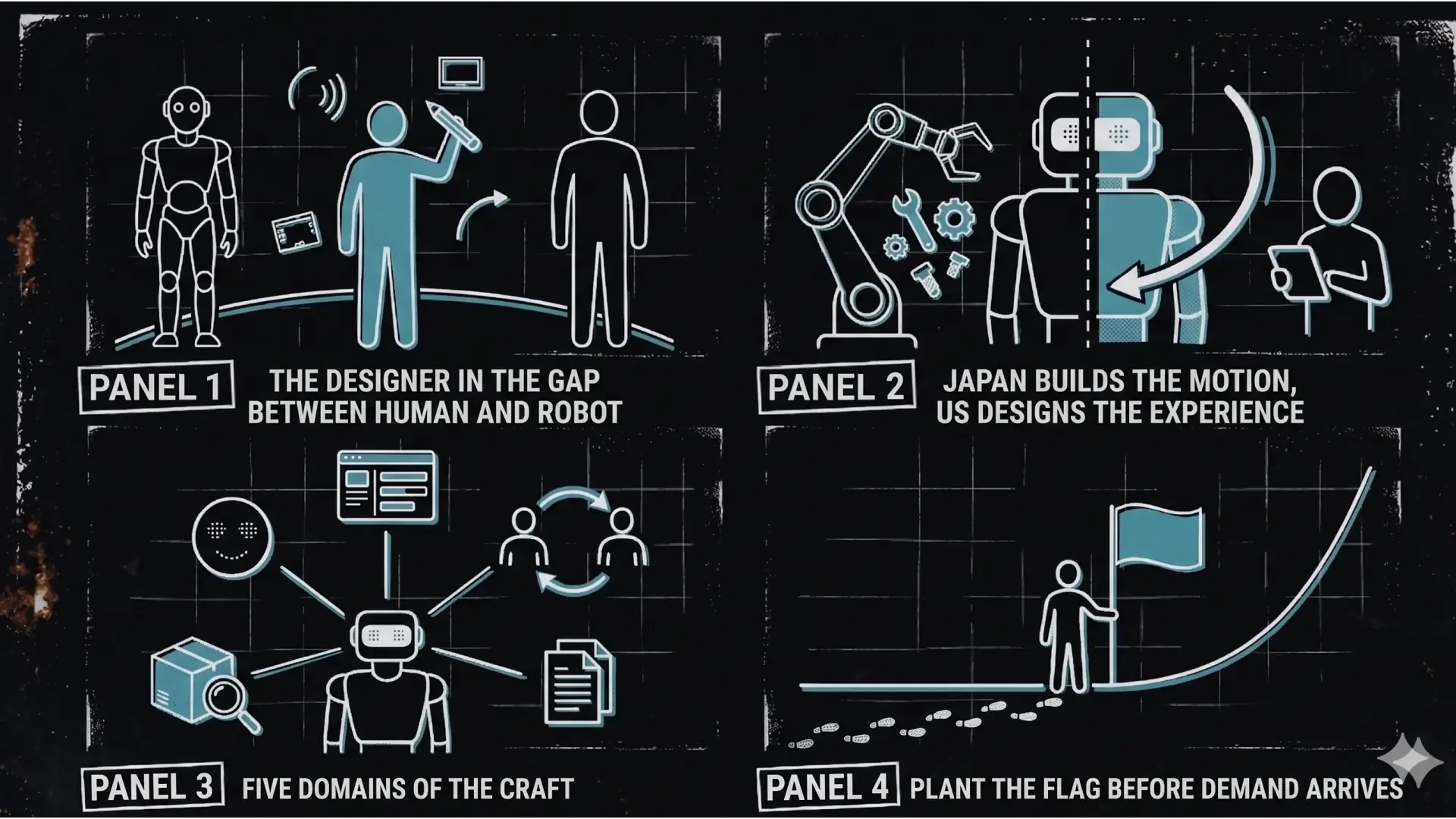
The Physical AI market is beginning to take shape. The question is who gets to define what "robot experience design" means — and the answer turns out to have nothing to do with technology. Category ownership starts with language.
💡 Key Takeaway
"Motion UX" and "Robotics UX" are effectively empty search territories today. Before the Physical AI inflection point arrives, the only viable strategy for a solo designer is to own the language before anyone else does.
Search "Motion UX" and See What's Missing
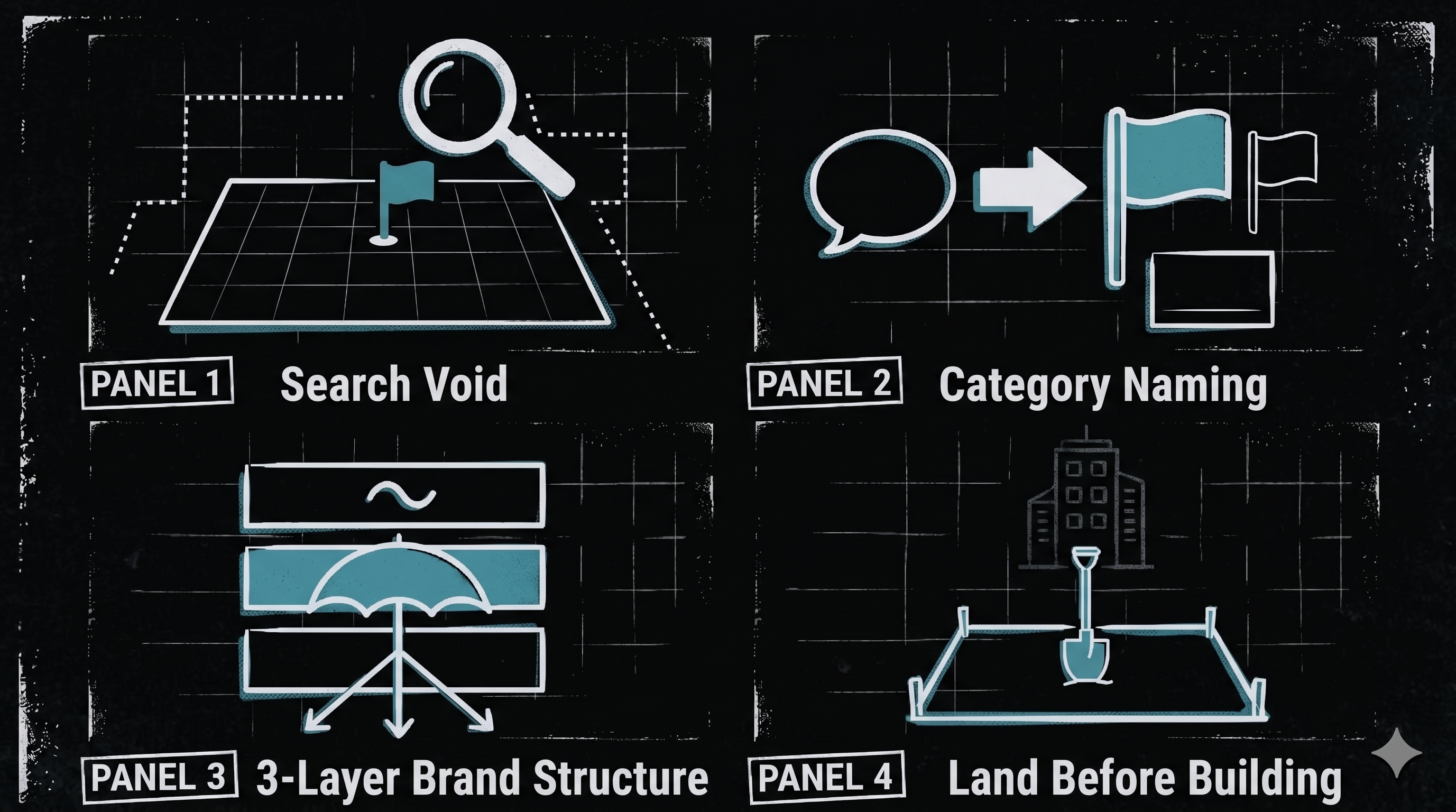
Search "Motion UX" right now and you get UI animation content. Framer Motion tutorials. After Effects walkthroughs. Design tool comparisons. Almost nothing using the term in the context of designing robot movement as a user experience.
Search "Robotics UX" and you get a university curriculum page and a fintech company that happens to have "ROBOT" in its name. No individual designer is claiming that phrase as their professional identity.
"Physical AI UX" returns nothing at all.
This isn't proof that the space has no value. It's proof that no one has planted a flag yet. Those two things are completely different.
That unflagged territory is likely to fill in fast — within the next 6 to 24 months. NVIDIA, Figure, Agility Robotics, and the media ecosystem around them are going to need language to describe what they're building. The question is whether that language already exists with your name on it.
The problem isn't that it's too early. The problem is not having a name ready.
What Category Creation Actually Looks Like
Drift was founded in 2015. Intercom already owned Live Chat. Rather than compete on that turf, Drift invented "Conversational Marketing" and became its defining voice. By the time Salesloft acquired them in 2024, ARR had grown from $6M to $135M.
Gong dropped "Conversation Intelligence" and coined "Revenue Intelligence." Eighteen months later, both Forrester and Gartner had adopted the category name in their own reports.
HubSpot didn't compete in marketing automation. They created "Inbound Marketing" and positioned themselves as its originator.
None of these companies won on technical superiority. They won on naming.
The structure is consistent: whoever names the problem becomes the authority on solving it. This isn't unique to B2B SaaS. It works exactly the same way for individual brand-builders.
Ryan Holiday redefined Stoicism for a modern audience. Tiago Forte built an entire ecosystem around "Building a Second Brain." David Perell carved out a corner of online education with "Write of Passage." Naval Ravikant rewrote how people think about wealth with two words: "Specific Knowledge." None of them won through technical advantage. They won by getting there first with a name.
The Three-Layer Structure
Thinking through how to make Pixels to Motors work as a brand reveals three distinct layers.
Layer | Role | Name |
|---|---|---|
Market context (borrow) | Ride the wave NVIDIA already created | Physical AI |
Brand umbrella (own) | The concept that contains the whole philosophy | Pixels to Motors |
Branch concepts (grow) | The specific terms to capture search and SEO | Motion UX / Robotics UX / Physical AI UX |
The top layer isn't worth fighting over. "Physical AI" belongs to NVIDIA, ITmedia, Nikkei, and WIRED. That's fine — use it as a wave to ride, not a hill to take.
The middle layer is the brand umbrella. "Pixels to Motors" goes here: the concept that wraps the entire philosophy of translating digital data into physical motion. This is the layer that becomes yours.
The bottom layer is where the daily work lands. "Motion UX," "Robotics UX," "Physical AI UX" — these are the specific terms to build out through articles, build logs, and essays. Currently empty. Currently available.
The structure works because it creates a funnel: someone searching for "Physical AI UX" hits the Pixels to Motors hub, which connects them to the Motion UX and Robotics UX definitions. Pixels to Motors functions as the transit point. Once your flag is in that hub, the downstream conversation happens in your language.
The Risk of "Too Early" Is Smaller Than It Looks
The standard objection to early category creation is that the market might not materialize before you run out of energy. That concern is partially valid — but the risk structure here is different.
Content is already being produced daily. The Pixels to Motors build log is over 180 days in, and articles about "mechArm 270 Pi" are ranking in Google search. The category-building is already happening at zero marginal cost. There's no visible competition. No individual designer in the Japanese-language space is consistently writing at the intersection of physical hardware, UX, and robotics. And the market timing is favorable — ABI Research forecasts humanoid robot shipments to hit their inflection point in 2026–2027.
The real problem isn't moving too early. It's writing every day without attaching a category name to the work. Articles without a framework are disconnected dots. Dots become a line only when the framework has a name.
The late-mover risk is more concrete. The moment a major media outlet, a VC-backed startup, or a corporate marketing team starts using "Robotics UX" or "Physical AI UX" — you become a follower, not a definer. That asymmetry, once established, is extremely difficult to reverse.
Citation as the Only KPI That Matters
The metric that signals category success isn't follower count or article volume. It's whether other people start using your language.
When someone writes "thinking about this through the Pixels to Motors framework" in a blog post or LinkedIn comment — that's the signal. When someone says "there's this concept called Motion UX" without being prompted — that's the signal. Five unprompted citations in the first twelve months is enough. If that number stays at zero, something needs to change: the naming, the definition, or the distribution.
What happens as citations accumulate? Every time your language appears in someone else's writing, it gets indexed. The authority of the term builds in a distributed way — structurally similar to how backlinks work for SEO. Drift letting competitors use "Conversational Marketing" wasn't generosity. It was strategy. The more the language spreads, the stronger the originator's position becomes.
The only losing move in category creation is trying to keep the language to yourself. A term that doesn't spread is just a neologism.
What It Means to Publish from Akita
Not being in Tokyo, not belonging to a large company, not being affiliated with a research institution — these look like disadvantages. In the context of category creation, they're actually differentiators.
"Not a corporation, not a lab — just a solo designer in Akita running an iPhone, Unity, and a robot arm every day" is a proof of reproducibility. When that lands, it creates a specific kind of gravitational pull: maybe I could do this too.
"Experience over precision — precision is solvable later with money" is a design philosophy that only holds weight when backed by proof. The proof isn't a number. It's 180+ days of documented build logs.
Geographic distance functions as a metaphor for low barrier to entry. And when a metaphor works, language moves.
The Structure of Starting Now
The action is straightforward.
Write one hub article that defines what Pixels to Motors is. Make that article the reference point for everything written after it. When writing about Motion UX, note explicitly that it's a branch concept under Pixels to Motors. Same for Robotics UX. Same for Physical AI UX.
Every new article adds a link back to the hub. Every link back to the hub builds definitional authority. That authority compounds into search rankings, then citations, then eventually the credit of being the person who created the language.
This is content strategy and intellectual property formation at the same time. Not a patent — prior definition. The asset accumulates through the act of writing.
Secure the Land First
Monetization comes later. Consulting, books, speaking, education programs — which of those is right depends on what the market looks like when it matures. That's a decision for after the land is secured.
People who design the building before finding the land discover too late that the land they wanted is already someone else's.
May 2026. Probably one to two years before the humanoid robot shipment inflection point.
Put the language down now, inside that window.