The Three-Phase Model of Motion UX
A response to frog's Nome — and a proposal for a profession that doesn't exist yet
When frog published Nome, most of the attention went to the aesthetics. A concept robot with considered proportions, thoughtful posture, a clear point of view about how a physical machine should inhabit human space. The robotics and design communities noted it. A few publications covered it. And then the conversation moved on.
That's the wrong response. Nome isn't primarily a product concept. It's an argument — a structured intellectual position about what design has to do with Physical AI adoption. And embedded in that argument is something frog chose not to fully articulate: a temporal framework for how humans and robots build a relationship.
This article reads that framework out of Nome, adds a dimension frog left implicit, and proposes a three-phase model for what I'm calling Motion UX. It then outlines a three-layer product roadmap for a profession that currently doesn't have a name, a curriculum, or a job listing — and argues that building it has to start from the bottom layer, with language.
What frog is actually saying with Nome
frog (part of Capgemini Invent) describes Nome on its Work page not as a product proposal but as a methodology demonstration. The section structure itself gives this away: context mapping, form design, interaction design, motion design, ecosystem design. That's not a product specification. That's a consulting engagement structure made visible.
The thesis appears plainly on the site. "Nome reflects frog's belief that adoption is a design problem." Capability, in other words, isn't the bottleneck. Robots that can perform tasks already exist. The reason they fail to enter homes, hospitals, and shared workspaces isn't technical — it's that no one has designed the experience of encountering them, living with them, trusting them.
Inna Lobel, frog's North American head of industrial design, sharpens this into a single line that anchors everything Nome is doing: "Form is the first interface of robotics." The same dynamic that governs screen UI — judged before you touch it — applies to physical machines. Before a robot does anything, a human has already decided whether to approach or retreat.
The design response frog develops from this premise is internally coherent. A Day in the Life mapping breaks a robot's operational cycle into nine moments — Wake up, Go to a task, Complete task, Requested, Interact with human, Interact with other bot(s), Ready for task, Low energy, Charge — and defines behavior at each moment across three layers: HRI (human-robot interaction), RxD (robot experience design), and RRI (robot-robot interaction). Motion Signature frames a robot's characteristic movement pattern — its pace, posture, responsiveness — as brand identity legible from a distance. Five experience principles function as ethical filters on design decisions. The fifth principle deserves quoting directly: "Automate the Drudgery, Not the Joy." Don't take from people what they find meaning in doing themselves.
Taken together, Nome represents the most coherent published framework I've seen for what it means to design a robot as an experience rather than a machine.
The two time horizons frog handles — and the one it doesn't
What makes Nome worth reading carefully rather than just admiring is what frog does with time.
frog writes explicitly that it approached Nome's interaction design "across two time horizons." The first is the moment-level: how a robot responds in a specific instant, during a specific interaction. The second is the system-level: the continuous experience that emerges over repeated use. A Day in the Life operates on the system-level horizon — Wake up to Charge is a cycle that repeats, a day that ends and begins again. Motion Signature operates on both, since a robot's movement identity consolidates over repeated encounters.
This dual-horizon thinking is genuinely sophisticated. Most robotics HRI work focuses on individual interactions, ignoring the cumulative character of repeated encounters. frog's insistence that both levels must be designed simultaneously is the right call.
But there's a third time horizon that frog doesn't name explicitly, though the conditions for it appear everywhere in Nome.
Before the daily loop, before the brand identity consolidates, there's the initial encounter. The moment a human first sees a robot. The seconds that follow. The decision — usually unconscious, usually irreversible — about whether this thing belongs in the space or doesn't. Whether to approach or step back.
That encounter isn't part of frog's Day in the Life. The cycle begins after acceptance has already been granted. But acceptance has to be earned before the cycle can begin. And the design of that earning — the passage from stranger to presence to inhabitant — is exactly what frog's two time horizons assume but don't directly address.
This is where the three-phase model starts.
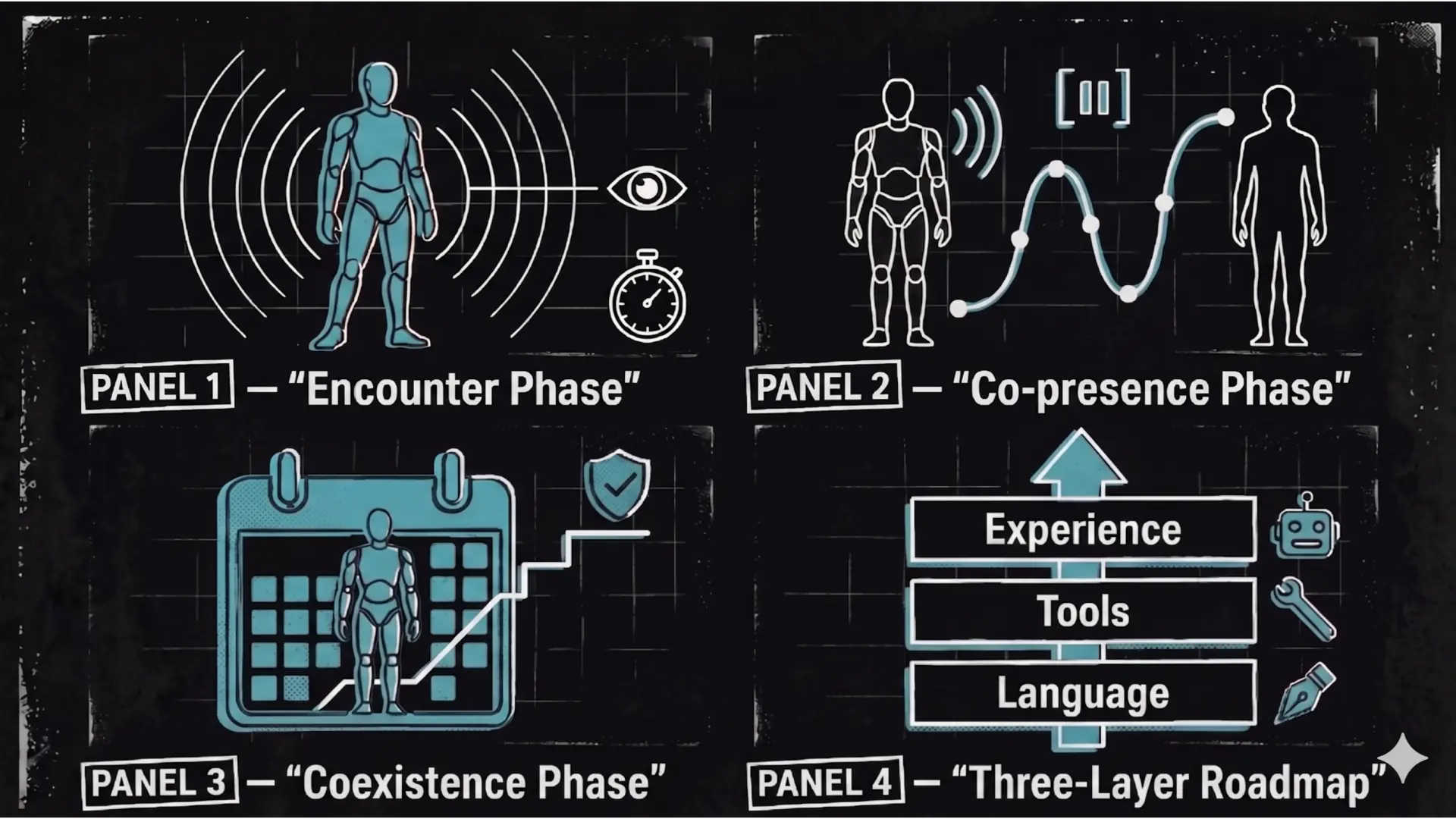
The Three-Phase Model of Motion UX
Matter exists in three phases — solid, liquid, gas. Each phase has different properties, different behaviors, different design constraints. The model I'm proposing treats the human-robot relationship the same way: three distinct phases, each with a dominant sense modality, a characteristic time scale, and a specific set of design targets. Each phase also corresponds to one of frog's three design axes — Approachability, Presence, Autonomy — but temporally ordered rather than held in parallel.
Phase | Name | Time scale | Dominant sense | frog axis |
|---|---|---|---|---|
Phase 1 | Encounter | Milliseconds → seconds | Visual | Approachability |
Phase 2 | Co-presence | Seconds → minutes | Movement / sound / interval | Presence |
Phase 3 | Coexistence | Days → months | Accumulated trust | Autonomy |
The intent of this model isn't to replace frog's axes — Approachability, Presence, and Autonomy are genuinely useful categories. The intent is to sequence them. Because the sequence matters enormously for design decisions, resource allocation, and evaluation criteria.
Phase 1: Encounter
The dominant sense is vision. The time window is milliseconds to seconds. This is the phase from the moment a human first sees a robot to the moment they make the decision — conscious or not — about whether to approach or avoid.
The design targets in this phase are: form, proportion, silhouette, surface treatment, color, scale, and parking pose. That last item deserves attention. A parking pose is the posture a robot holds when it isn't doing anything — waiting, idle, at rest. A robot's parking pose is the face it shows the world between tasks. It's what people see in the fraction of a second before they decide whether to keep walking or stop.
frog's treatment of this phase is the most original contribution in all of Nome. They introduce contrapposto — the ancient Greek and Renaissance sculptural technique of placing the body's weight on one foot, creating an S-curve through hips and shoulders — as a principle for robot posture design. Weight shift, relaxed poses, center of gravity, opposing angles. The goal, as frog writes, is "a sense of life even in stillness." A machine standing straight with both feet together reads as dormant, mechanical, potentially threatening in its rigidity. A machine with even subtle weight distribution asymmetry reads as poised, alert, alive.
This is industrial design reaching into sculpture theory — accessing thousands of years of accumulated human understanding of how embodied posture communicates. The Phase 1 design space is rich with this kind of cross-disciplinary borrowing.
The rule for Phase 1 is simple but severe: if a robot is rejected here, Phase 2 never begins. It doesn't matter how elegant the motion, how sophisticated the interaction logic, how refined the Motion Signature if a person decides in the first two seconds that they don't want to be near this thing. In early-stage products and demonstration contexts, it's rational to put a disproportionate share of design investment into Phase 1.
Phase 2: Co-presence
The dominant senses are movement, sound, and interval. The time window is seconds to minutes. This is the phase where a human and a robot share space and are aware of each other — where the quality of coexistence is built in real time, interaction by interaction.
The design targets in this phase include: acceleration and deceleration profiles, gaze direction, operational sounds, signal sounds, the use of silence, idle micro-movements (or the deliberate absence of them), recovery behavior after failure, and ma — the Japanese concept of interval, pause, the space between actions that carries as much meaning as the actions themselves.
This is Motion UX's primary territory. Form, once manufactured, is fixed. But movement is a line of code. Every parameter is a design decision: how quickly does the robot accelerate out of rest? Does it pause before reaching for an object? How does it signal that it understood an instruction? What does it do when it fails to grasp something? Each of these choices accumulates into an overall sense of whether sharing space with this machine is comfortable, legible, trustworthy — or unsettling.
frog's concept of Motion Signature lives here, and it's worth distinguishing carefully from what I mean by Motion UX. frog frames Motion Signature as brand identity — "A robot's motion signature becomes recognizable from afar." Pace, posture, responsiveness combine into an identity that distinguishes one robot from another, the way one brand of consumer electronics feels different from another.
My Motion UX is concerned with something prior to brand identity: whether the movement functions at all as a communication medium between the robot and the human sharing space with it. Before a motion can be a signature, it has to be acceptable. Before it can be distinctive, it has to be legible. Motion UX addresses the conditions for acceptance and legibility. Motion Signature builds on top of those conditions.
The two aren't competing frameworks. They're sequential. Motion UX (acceptance through movement) is the substrate. Motion Signature (differentiation through movement) is the layer that builds on it. No acceptance, no differentiation.
Phase 3: Coexistence
The dominant sense — if that word still applies — is accumulated trust. The time window is days, weeks, months, years. This is the phase where a human has granted a robot a place in their life, where the robot has become a known quantity, where the relationship is no longer about impression management but about consistency, adaptability, and predictability over time.
The design targets in this phase are: consistency of judgment, legibility of learning, adaptation to established habits, behavior during maintenance or failure states, and response to changes in the relationship itself.
frog's Day in the Life mapping describes this phase from the inside — it's an account of what a robot's operational cycle looks like once a human has already accepted it as a routine presence. The cycle from Wake up to Charge assumes that the human has already granted the robot a place in the household. Phase 3 is the phase where that grant is maintained — or revoked.
In the three-phase model, frog's two time horizons (moment-level response and system-level continuity) both operate within Phase 3. The Day in the Life loop is a Phase 3 structure. frog's two time horizons are the micro and macro structure of what it means to live with a robot. The three-phase model situates that structure in context: it's what happens after Phases 1 and 2 have succeeded.
Reading frog's design vocabulary against the three phases
Having established the model, it's worth returning to specific elements of Nome and locating them within the phase structure. frog's design vocabulary is rich enough to support this mapping.
Five experience principles — an ethical filter at every phase
frog's five principles for Nome are worth quoting in full:
Design for Context and Meaning
Match Capability with Expression
Design for Natural Interaction
Design for Collaboration
Automate the Drudgery, Not the Joy
The fifth principle is the most operationally significant. It functions as a constraint on feature addition: before adding a capability, ask whether automating this takes something meaningful away from the human. This is an ethical decision procedure, not a design heuristic. It applies at every phase, but its weight varies: in Phase 1 it governs form decisions (does this robot look like it's trying to replace something?), in Phase 2 it governs interaction design (does this motion communicate partnership or displacement?), in Phase 3 it governs adaptation (does learning the human's patterns feel helpful or surveilled?).
Three-phase model covers resource allocation strategy. frog's five principles cover capability selection ethics. They're complementary. Running both simultaneously produces more robust design judgment than either alone.
Contrapposto — Phase 1 depth through sculpture theory
The contrapposto insight deserves more attention than it typically gets. frog is doing something genuinely unusual here: reaching into art history — specifically into the shift in Greek sculpture from the rigid archaic style to the classical contrapposto pose around 480 BC — to solve a robotics design problem.
The implication for Phase 1 design is significant. It suggests that the relevant knowledge base for Encounter Phase design isn't primarily robotics or even product design. It's sculpture, theater, dance — disciplines that have spent millennia figuring out how embodied posture communicates to humans. A Motion UX designer working in Phase 1 might learn more from Laban Movement Analysis than from robot kinematics.
This cross-disciplinary borrowing is exactly what a new profession needs to do at its founding. The territory is new. The knowledge to navigate it isn't.
What Motion UX designers actually make — a three-layer product roadmap
A framework without a production plan is an essay. If Motion UX is a genuine profession rather than an analytical category, it needs a concrete account of what people who practice it actually produce. The three-phase model implies a set of outputs. Here I want to make that implication explicit in the form of a three-layer product roadmap.
The structure is bottom-up. Layer 3 (language) comes first. Layer 2 (tools) can only be built on top of established language. Layer 1 (experiences) can only be produced at scale on top of functional tools.
Layer 3 — Language: Making discussion possible
The foundational layer is vocabulary and frameworks. Before a profession can exist, there has to be a shared language for what it does. Before a client can hire a Motion UX designer, they need to know what to ask for. Before a designer can evaluate their own work, they need a terminology that lets them distinguish good from bad in articulable ways.
The specific outputs at this layer are three.
Motion UX Glossary. Terms with stable definitions: Encounter Phase, Co-presence Phase, Coexistence Phase, Parking Pose, Motion Signature, Ma (interval), Recovery, Anticipation, Resolution. These need to be defined precisely enough that two people using them can have a productive disagreement — which is the minimal bar for any working vocabulary. frog's Nome page is beginning to do this work in English for the concepts it introduces. In Japanese, the work is largely unstarted.
Motion UX Pattern Language. Following Christopher Alexander's approach in A Pattern Language — systematic documentation of recurring design solutions. Patterns like: Approach Without Intrusion (closing distance without triggering avoidance response), Yield With Grace (ceding right of way in a way that communicates awareness rather than malfunction), Pause Before Action (the beat of anticipation that lets humans predict what the robot is about to do), Soft Recovery (the movement sequence after a failure that preserves trust rather than breaking it). Each pattern has a name, a context, a description of the problem it addresses, and a description of the solution. Patterns can be combined. They can be referenced in design discussions without lengthy re-explanation.
Motion UX Design Principles. A set of principles derived from the three-phase model itself, in a form that's usable as a checklist during design review. Principles like: Don't skip phases (a robot that commits Phase 1 is prerequisite to everything else). Allocate by context, not balance (Phase 1 deserves nine-tenths of the investment in demo contexts; Phase 2 deserves it in service contexts). Evaluate each phase on its own criteria (Phase 1 is evaluated by instant response, Phase 2 by accumulated naturalness, Phase 3 by consistency over time; applying the same metric to all three phases produces meaningless results).
Layer 3 requires almost no capital. It requires a writer, sustained time, and other designers to pressure-test the vocabulary. That's why it's where to start.
Layer 2 — Tools: Making design possible
Once language is established, tools can be built that use that language to make design decisions more tractable. Motion UX designers will need tools that don't currently exist anywhere.
Three tools are necessary at minimum.
Three-Phase Diagnostic Tool. A lightweight decision support tool that takes context inputs (venue: exhibition, hospital, household; development stage: early prototype, pre-commercial, operational; primary goal: brand visibility, functional verification, long-term use) and outputs a recommended resource allocation across the three phases. The logic is: each context implies different priorities, and making those priorities explicit before design begins prevents the most common failure mode, which is spending Phase 2 effort on a product that hasn't solved Phase 1. This starts as a web-based form. It can grow into team-oriented SaaS.
Day in the Life Mapping Template. frog shows the template; this tool makes it available to practitioners. A matrix with life moments on one axis (in a format generalizable beyond Nome's nine moments) and interaction layers on the other, with the three-phase designation of each cell made explicit. Available in Notion, Figma, and Miro formats. The distinction from frog's version: phase-consciousness is built in. Each cell is tagged with which phase of the human-robot relationship it addresses.
Motion Signature Profiler. A tool that makes visible the movement identity of a robot — its characteristic acceleration curve, postural tendencies, response time variance — and enables comparison between design options. Implementation paths include a Unity plugin (which fits the R2R2R toolchain), a standalone video analysis tool, or a simulator-agnostic interface. The goal is to make Movement identities comparable rather than only intuitable. A designer should be able to say "Option A has a longer anticipation pause and slower deceleration" in a way that's grounded in measurable parameters rather than subjective impression.
Layer 2 cannot be built without Layer 3 in place. Tools built on undefined vocabulary become unusable or unused. The language has to come first.
Layer 1 — Experience: What actually enters the world
At the top of the stack is what end users ultimately encounter: the motion, posture, and timing of a robot in its actual operating environment. This is the final output of Motion UX design, and it's what makes the existence of the profession legible to people outside it.
Two directions of output at this layer.
Motion Library. Context-specific motion presets, produced and documented using the pattern language from Layer 3 and evaluated using the tools from Layer 2. "Motion that attracts attention in exhibition contexts." "Motion that communicates safety in medical environments." "Motion that settles into routine in domestic environments." Each motion set is documented with the phase reasoning behind it — which phase it primarily addresses, what evaluation criteria apply, what tradeoffs were made. Distributed through Unity Asset Store, Unreal Engine Marketplace, or a dedicated platform.
Posture Set. Parking pose templates derived from contrapposto principles, applicable to different robot morphologies and joint configurations. Robot manufacturers need to implement idle postures for their hardware; doing this well from scratch is expensive. A Posture Set gives manufacturers a starting point that already reflects the accumulated wisdom of Phase 1 design. Each posture is documented with the weight distribution logic and the Phase 1 evaluation criteria it's optimized for.
Layer 1 cannot be produced at library scale without Layer 2 in place. Individual motions can be made through craft; reproducible, comparable, documented motion libraries require evaluation tools. The tools have to come first.
Why the build order is reversed from frog's
frog proceeded in the opposite sequence. Nome — a Layer 1 product — is the entry point. The methodology (Layer 2 thinking) is implied behind it. The vocabulary (Layer 3) is scattered throughout the write-up in fragments.
This is the correct strategy for an established design firm: ship a visible product, create impact, then sell the methodology and language that generated it. The product creates proof of concept. Proof of concept creates demand for the framework.
For someone establishing a profession that doesn't yet exist, this order is inverted — and for good reasons.
First: professions begin with language. "Motion UX designer" can't appear in a job listing until someone has defined what that title covers and what it doesn't. It can't appear in a curriculum until the vocabulary is stable enough to teach. Language is the enabling condition for professional recognition. Without it, even demonstrated craft is invisible as a profession.
Second: Layer 3 compounds. A Motion UX Glossary, once written, gets referenced repeatedly. A pattern language, once established, enables design conversations that couldn't happen before. These are assets with high reuse value — they work harder over time, not less hard. The investment at Layer 3 has the highest long-term leverage.
Third: the sequencing constraint is real. Tools built on undefined vocabulary fail. Experiences produced without evaluation tools can't be documented, compared, or iterated systematically. The bottom-up order isn't ideological — it's structural.
Four implications of the model
The three-phase model produces four specific claims about how to think about robot experience design. Each is a direct contradiction of something that currently passes as standard practice.
Each phase requires different evaluation criteria. Phase 1 is evaluated by immediate intuitive response — safety or threat, approach or avoid. Phase 2 is evaluated by cumulative naturalness — the total weight of oddness or comfort over an extended interaction. Phase 3 is evaluated by trust — the frequency of broken expectations over time. Using the same benchmark across all three phases produces invalid comparisons. The confusion between precision benchmarks and experience evaluation that characterizes current robotics research is partly explained by the phase problem: the field is trying to evaluate Phase 2 and Phase 3 outcomes with Phase 1 criteria.
Phases can't be skipped. A robot rejected in Phase 1 never reaches Phase 2. A robot that creates persistent discomfort in Phase 2 never reaches Phase 3. This is the precise structure of why humanoid robots that perform impressive demo capabilities fail to find domestic adoption. The demos are designed to provoke Phase 3 responses — look at what this thing can do in a household — while the fundamental Phase 1 and Phase 2 work hasn't been done. Demonstrations that skip phases make promises the actual product can't keep.
Allocation is about context, not balance. In exhibition and demonstration contexts, Phase 1 deserves the overwhelming majority of design investment. In service robot contexts (navigation, guidance, delivery), Phase 2 is the decisive factor. In domestic personal robot contexts, Phase 3 becomes the primary differentiator. The relevant question isn't "how do we balance Approachability, Presence, and Autonomy?" but "what phase does this context primarily require, and how do we concentrate resources there?"
This defines the precise scope of "precision can be solved with money later." The claim that precision is a downstream problem — that you should prioritize experience over specification in early development — is broadly right but imprecisely bounded. Phase 1 precision (form, proportion, material) is nearly impossible to retrofit once manufacturing has started. Phase 2 precision (motion parameters) is partially retrofittable through software updates. Phase 3 precision (consistency of judgment, learning behavior) is largely retrofittable. The three-phase model gives the claim "precision can wait" its valid scope. Without that scope, it becomes an excuse for avoidance rather than a strategy.
What this model doesn't resolve
An honest account of the model includes its limits.
The three phases aren't cleanly separated in actual experience. When someone sees a robot moving for the first time, form and motion are evaluated simultaneously. The encounter and co-presence phases overlap in practice. The three phases are analytical lenses, not temporal partitions.
Phase 3 is underspecified. There is almost no longitudinal data on long-term human-robot coexistence outside of single-function devices like Roomba. The claims about Phase 3 design targets — consistency of judgment, legibility of learning, adaptation to habits — are based on inference from adjacent domains (long-term product relationships, service design, behavior change design) rather than direct robotics research. Phase 3 is the part of this model most likely to require revision as evidence accumulates.
Cultural weighting across the phases isn't addressed. What constitutes "natural" movement in Phase 2 varies significantly across contexts. Whether Phase 3 trust is built primarily through competence demonstration or through non-intrusion probably varies by culture. The three-phase model describes a structure without specifying its content for particular human contexts — that content has to be determined through research that this model doesn't itself produce.
A profession that starts now, from language
frog's Nome is built by industrial designers — Inna Lobel, Katie Lim, Tom Frejowski — extending industrial design into Physical AI territory. This is a legitimate move, and it produces real insight. Form is indeed the first interface. Motion Signature is a genuine design concept. The five experience principles are a working ethical framework.
But industrial design, extended, isn't quite the same thing as a dedicated profession for designing how robots relate to humans through movement over time. Industrial design's primary territory is form and function. What the three-phase model points toward is a profession whose primary territory is the temporal structure of the human-robot relationship — and the design of movement as the medium through which that relationship is built or broken.
Motion UX designer isn't a UX designer who specializes in robots. It isn't an interaction designer. It isn't an animator or a choreographer or a robotics engineer. It's adjacent to all of these and identical to none of them. The profession is new because the problem is new: designing the relationship between humans and mobile, capable physical machines that share space with them, not for a single interaction but over days and years.
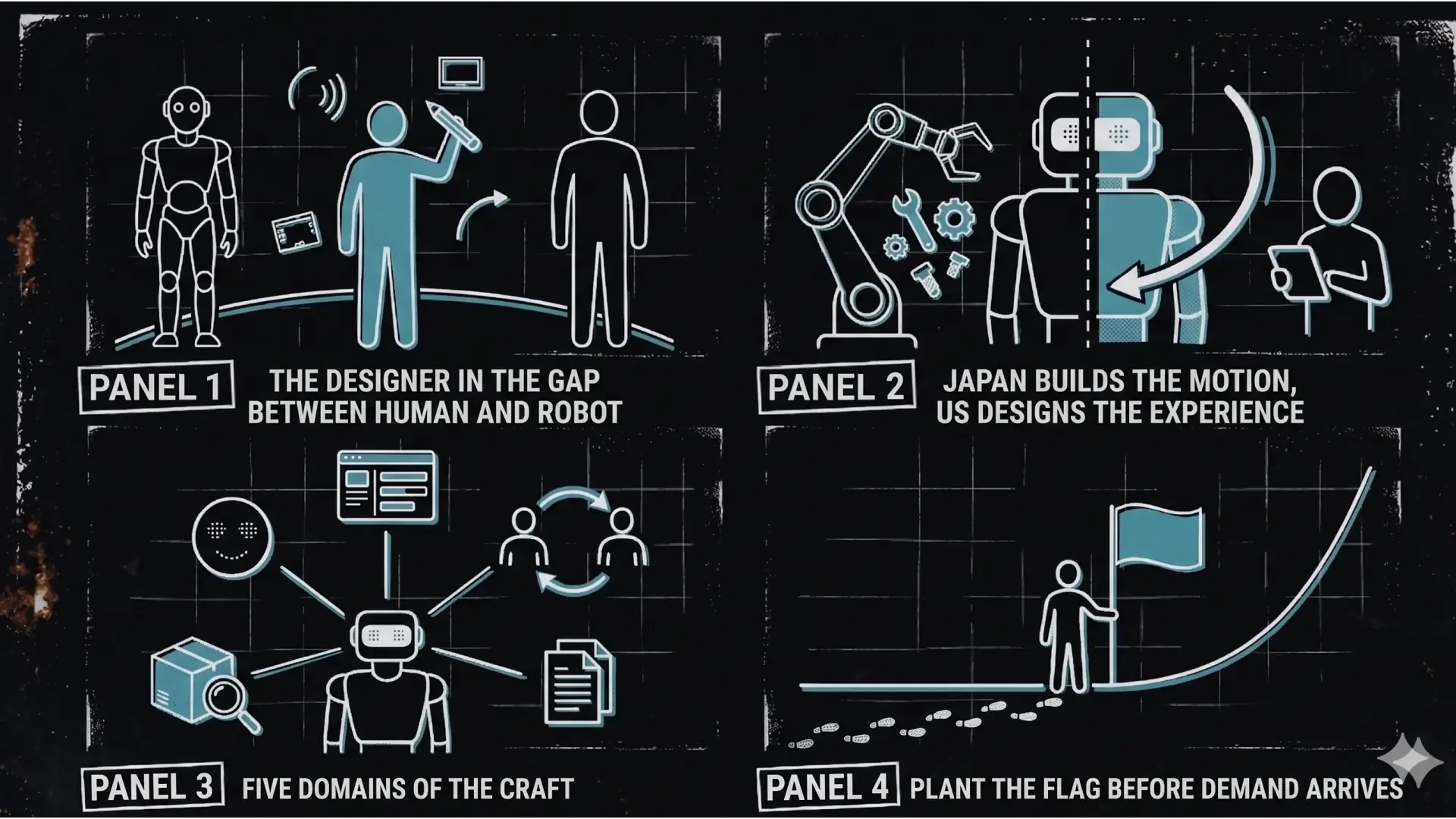
The Physical AI conversation is almost entirely conducted in English, by US and Chinese companies, on US and Chinese platforms. NVIDIA's GR00T, Isaac Sim, Cosmos — the infrastructure that may define how robot motion is generated and evaluated for the next decade — is being written in English. Boston Dynamics, Figure, 1X, Apptronik are setting precedents about what robots should do and how they should move. The design vocabulary for Physical AI is being established by people in Boston, San Francisco, Seattle, and Oslo.
Japan has world-class hardware manufacturing, deep precision knowledge, and a cultural archive around interval, silence, and the expressive quality of movement that has direct relevance to Phase 2 design. That knowledge base is not yet connected to the Physical AI design conversation. Connecting it requires, first, a language in which that connection can be made.
29 years of design experience. A machine shop background from industrial high school. RC vehicle manufacturing. UI/UX across multiple industries. The full R2R2R pipeline: iPhone scan to Unity digital twin to simulation optimization to physical robot. These aren't individually sufficient to establish a profession. Together, they make a specific kind of argument: that someone without institutional affiliation, without a research lab, without a large team, can contribute to the design vocabulary for Physical AI — if they're willing to start at Layer 3 and build up.
frog is drawing one map of this territory. This is a different map — from a different position, adding a dimension frog left implicit.
The three-phase model is the first line of the Motion UX vocabulary. The three-layer roadmap is the production plan. Both are drafts. The useful thing about drafts is that they invite revision from people who know things the author doesn't.
If you're thinking about robot experience design, Motion UX, or the human side of Physical AI adoption, I'd like to hear from you.