Why Physical AI Won't Take Off in Japan — And It's Not About Technology
Japan is falling behind in the Physical AI era.
That statement is half right and half wrong. Japan isn't falling behind — it's stuck on a different problem entirely. And that problem isn't technology or funding. It's structural, and it runs deeper than most analyses acknowledge.
Start With a Contradiction
Consider the numbers first.
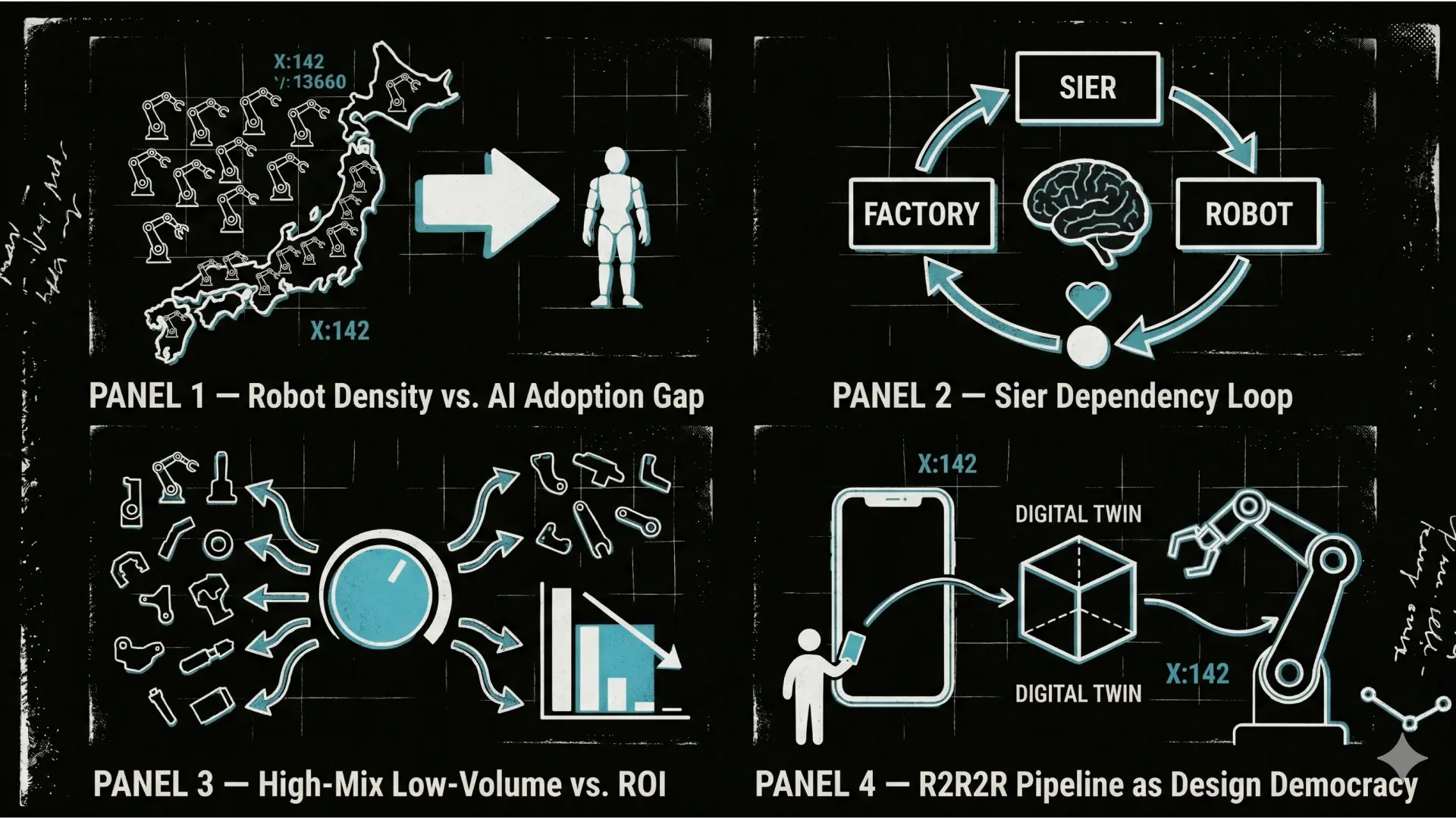
According to the International Federation of Robotics (IFR, 2024), Japan's robot density in manufacturing is 446 units per 10,000 employees — ranked 4th in the world. The global average is 132. Japan operates at more than three times the world standard. FANUC, Yaskawa, and Denso Wave collectively account for 38% of global industrial robot production. Japan literally keeps the world's robot industry running.
Now look at what's happening in Physical AI. In the US, Figure AI reached a $39.5 billion valuation, and Tesla is planning a production line of 100,000 Optimus units per month. In China, Unitree Robotics is shipping its G1 humanoid at roughly $13,700, with 2024 shipments reaching world-leading volumes. China's robotics investment is reportedly more than 10 times Japan's.
Japan is the undisputed world leader in building robots. Yet in Physical AI — using robots intelligently in the real world — it's losing ground on the implementation side. Understanding this contradiction is the core challenge.
The Wrong Diagnosis
The common framing is "Japan is falling behind." If that's the diagnosis, the prescription is "invest more, move faster." And indeed, Japan's 2026 budget allocated approximately ¥387.3 billion to Physical AI and foundation model development. The government declared it would "take on the world" with this.
But what if the problem isn't investment?
A Daiwa Research Institute report from April 2026 put it plainly: "Physical AI is not a field where progress happens naturally as AI technology advances — because it operates in the real world." The success of Physical AI deployment depends not only on technical performance, but on how well non-technical conditions are designed: safety, quality, and accountability boundaries.
Japan is stuck not on technology or funding, but on a design problem.
Structural Barrier 1 — The SIer Dependency That Empties Organizational Knowledge
To understand the problem, you need to understand Japan's dominant robot deployment model.
In Japan, the standard practice is to fully outsource robot deployment to a System Integrator (SIer). The SIer handles everything end-to-end: site survey, requirements definition, system design, hardware selection, software development, installation, calibration, staff training, and ongoing maintenance.
This model has obvious advantages. Companies with no in-house robotics expertise can still deploy robots. Risk is low. Maintenance is covered.
But there's a fatal side effect: organizational knowledge never accumulates.
When the SIer owns the design, the company never learns why specific motions were chosen, what logic drove the parameter settings, or how to adapt when conditions change. When the next deployment comes around, they call the SIer again. This cycle repeats. The result is a structure where knowledge deficits are permanent — not temporary.
METI itself designs its SME robot deployment support packages around the premise that "small and mid-sized companies cannot independently deploy robots and need support infrastructure." That's a rational response to reality — but it's also an acknowledgment that this dependency has persisted for decades without changing.
What Physical AI actually requires is organizational capability to redesign and re-learn motion when the environment changes. When an object is placed slightly differently. When lighting conditions shift. When a new product is added. If every change requires "file a request with the SIer and wait three months," the core value proposition of Physical AI is unreachable.
An organization without in-house capability can deploy Physical AI. But it cannot compete with Physical AI.
Structural Barrier 2 — High-Mix, Low-Volume Manufacturing Is Fundamentally Incompatible
Japan's manufacturing strength is high-mix, low-volume production. Whether automotive components or food products, Japan differentiates on variety and quality — not scale. This very strength is what suppresses robot deployment ROI.
On a mass production line, a robot configured once runs the same motion for years. The initial setup cost is amortized across enormous volume. But when configurations must be reset every time a product variant changes, labor costs compound and the ROI math breaks down.
METI's own analysis states explicitly: "For long-tail markets requiring high-mix, low-volume capability, developing individual robots for individual needs requires extended development timelines and high-cost structures, making deployment difficult."
The emerging solution is pairing general-purpose robots with small-dataset learning. Pre-verify motion in a digital twin environment, then deploy directly to hardware — structurally reducing the cost of motion configuration changes.
This is exactly what the R2R2R project is testing at individual scale. Scan with iPhone, build a digital twin in Unity, optimize motion in simulation, deploy to the physical robot. If this pipeline works, high-mix, low-volume environments become viable for robot deployment at a fraction of current costs.
Structural Barrier 3 — No One Is Designing for the People Who Use These Things
The most persistent gap in Japanese robot deployment is the absence of the user's perspective in the design process.
Whether a robot works is an entirely different question from whether a robot gets used.
NRI's CES 2026 report made this point directly: "User acceptance is a critical factor for adoption. Rather than aiming for 100% from day one, it's important to first create a state where people are willing to use it, while leaving room for human intervention." The way Waymo and Zoox are building trust in autonomous vehicles — through staged evidence, quantitative safety data, limited service areas — is the right model for any physical system entering human environments.
In Japanese manufacturing specifically, the problem is harder. There's deep cultural respect for skilled tradespeople. Robot deployment can be perceived as a denial of craft. This isn't sentiment — it functions as an organizational cultural barrier. Without floor-level cooperation, robots don't run. No matter how precise the motion, if workers don't report anomalies, the system stops.
In March 2026, NEC announced a Physical AI system that uses a proprietary "world model" to predict human movement and psychological state, adjusting robot motion proactively to reduce human anxiety. The goal: incorporate not just physical safety but psychological safety into robot control.
This is technology trying to solve a user acceptance problem. But technology alone can't solve it. How humans and robots share physical space, which tasks belong to whom, what happens when exceptions occur — these are design questions. And they require a kind of expertise that currently doesn't exist at scale in Japan.
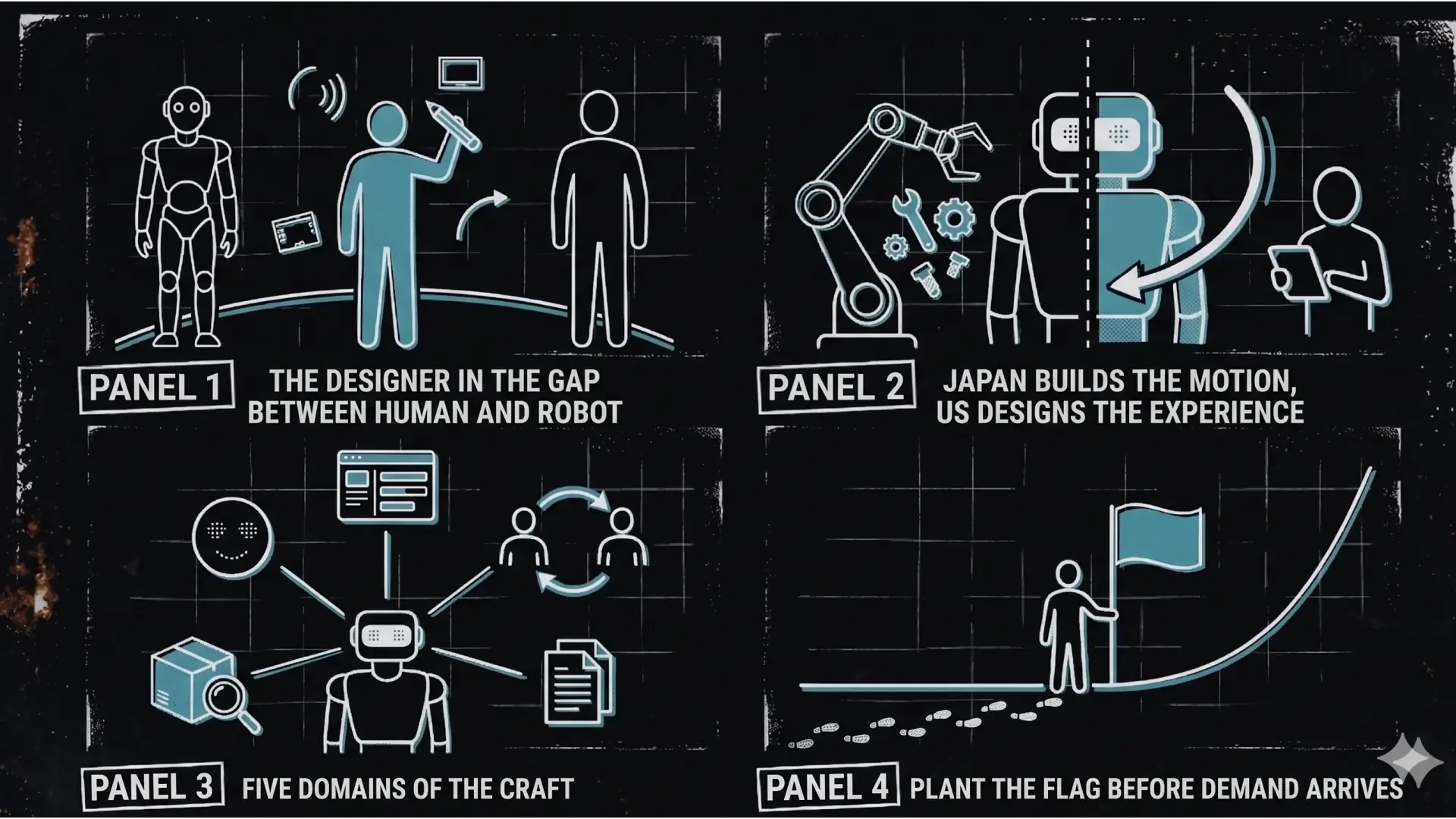
SIers are expert implementers. They are not expert designers. Robot engineers know how to make things move. They don't know how to design for how things get used. The gap between these two is where Physical AI deployment fails — and the people who can bridge it don't exist in Japan's job market.
Structural Barrier 4 — The Shift From "Want To" to "Have To"
Something has changed in why companies deploy robots.
The old motivation was cost reduction. Automate to lower labor costs, increase productivity. This was a choice available to companies with margin.
That's no longer the dominant story.
Japan's wage growth in 2024 hit 5.1% — the highest in 33 years. For small and medium enterprises, it was 4.45%. The government projects Japan's working-age population will decline by approximately 1.2 million people by 2040 — roughly a 20% reduction. The Japan Institute for Labour Policy and Training estimates that under current trends, employment will fall by approximately 9.5 million from 2022 levels by 2040.
The motivation has shifted from "we want to automate" to "we have no choice." For regional SMEs in particular, robot deployment is now survival adaptation.
This shift changes the economic math entirely. Under a cost-reduction framing, deployment stops when ROI can't be calculated. Under a "there are no people" framing, the ROI threshold changes. "Not automating is more expensive than automating" now describes more industries and company sizes than it did five years ago.
Industries with the highest pressure: logistics and warehousing (labor costs 40–60% of revenue), retail (25–35%), food processing (30–40%), construction and infrastructure (30–45%).
Demand is accelerating. The number of people who can design how to implement it is not. This supply-demand gap is Japan's real Physical AI bottleneck.
US vs. China vs. Japan — The Simulation Sovereignty Question
To understand the strategic difference, follow the data.
In the US, companies like Google and Meta have built closed-loop systems where robotics training data is collected, managed, and learned from entirely within proprietary infrastructure. No external data sharing needed. Pre-training, feedback, and model updates cycle at high speed. This closed improvement loop is a primary reason US companies advance faster than any other country.
In China, "data factories" are being built — facilities that replicate manual tasks like assembly, transport, and tool use, accumulating vision, force, and behavioral data at scale. Government-directed, high-fidelity real-world data feeds model improvement and field adaptability in a fast cycle.
Japan's approach: METI has positioned around "accelerating the growth of open data infrastructure to promote foundation model development and deployment." A differentiation through openness — distinct from US and Chinese proprietary models.
But the fundamental question is the same regardless of approach: who designs the motion, and who accumulates the data?
While the US and China compete on compute and production scale, Japan's potential advantage is field quality. Japan's manufacturing knowledge base — precision, high-mix experience, an almost compulsive commitment to quality — can be converted into robot motion design. But the people and methodology capable of that conversion don't yet exist at scale.
What's Actually Missing
Four structural barriers. One common thread.
Japan has plenty of people who can make robots move. Japan has almost no one who can design how robots should move.
Three cross-industry capability gaps are consistently missing:
Field-to-engineering translation. Converting what floor operators actually want ("move like this") into implementable robot specifications. Engineers can implement but don't know the work. Floor operators know the work but can't translate it technically. The person who can do both doesn't appear in job listings.
Human-robot workflow design. When humans and robots share physical space, decisions about where humans are positioned, how handoffs work, and what happens during exceptions require whole-system thinking. Traditional industrial robotics was designed to exclude humans from robot zones entirely. People with Human-Robot Collaboration (HRC) design experience are rare.
Experience validation and iteration. Evaluating deployed robot behavior continuously from the perspective of the people using it, and running improvement cycles. Robot development tends to treat "it works" as done. Organizational processes for continuous user-perspective validation barely exist.
These three capabilities can't be addressed separately by robotics engineering, UX design, or operational domain expertise alone. They only function when integrated. And there is almost no curriculum — at universities or vocational schools — that teaches all three together. If hiring can't solve it, training must. But the venue and methodology for that training don't yet exist either.
What R2R2R Is Testing
This project started partly because of this gap.
Testing whether SIer dependency can be dismantled. If a pipeline of iPhone scan → Unity digital twin → simulation optimization → physical robot deployment works, then motion design cycles can run without specialized equipment or large budgets. That's a form of design democratization.
Testing viability for high-mix, low-volume contexts. If digital twin pre-verification reduces physical deployment costs, then the cost of motion redesign per product variant changes structurally.
Building methodology for user-perspective motion design. Bringing UX design thinking into robot motion design — closing the gap between "a robot that works" and "a robot that gets used."
These remain hypotheses. Testing continues with physical hardware. But if they hold, some of Japan's Physical AI adoption barriers become structurally solvable.
What Japan's Physical AI Actually Needs
Japan's Physical AI adoption barrier isn't technology or funding.
World-class hardware exists. NVIDIA and Google platforms are available. The government has committed hundreds of billions of yen.
The reason adoption stalls is structural. SIer dependency prevents organizational knowledge from forming. High-mix, low-volume manufacturing breaks ROI calculations for robot deployment. No one is designing for user acceptance at the floor level. And the people who could address all of this — people who integrate field knowledge, engineering, and experience design — don't exist in hiring markets or training pipelines.
Japan's opportunity to deeply engage in AI using its manufacturing data still exists. But what's needed isn't investment or technical capability. It's people and methodology who can apply design thinking to physical systems.
If Japan has a path to winning in the Physical AI era, it runs through the ability to convert field quality into motion design. That's what this project is trying to prove — at individual scale, from the ground up.
R2R2R (Real2Render2Real) / Pixels to Motors
A daily public log project proving that a single person can design, optimize, and deploy robot grasping motion using only an iPhone and Unity. Inspired by UC Berkeley / Toyota Research Institute research, implemented at individual scale.