Robotics UX Designer | A Profession That Exists in the US, Not Yet in Japan
Whether a robot feels useful or unsettling, somebody decides where that line gets drawn. That somebody is barely employed in Japan. In the US, the same job pays $149K to $271K and has a team org chart. I broke the work down into five distinct areas.
Who decides whether a robot feels good to work with
Humanoid robots show up in videos more often now. A robot moving boxes through an Amazon warehouse. A robotic arm assisting in surgery. A receptionist robot standing at a hotel desk.
The person watching is already evaluating, without thinking about it. Is the motion smooth or jerky? Does the approach feel friendly or threatening? Are the instructions clear, or am I confused? These judgments happen in seconds.
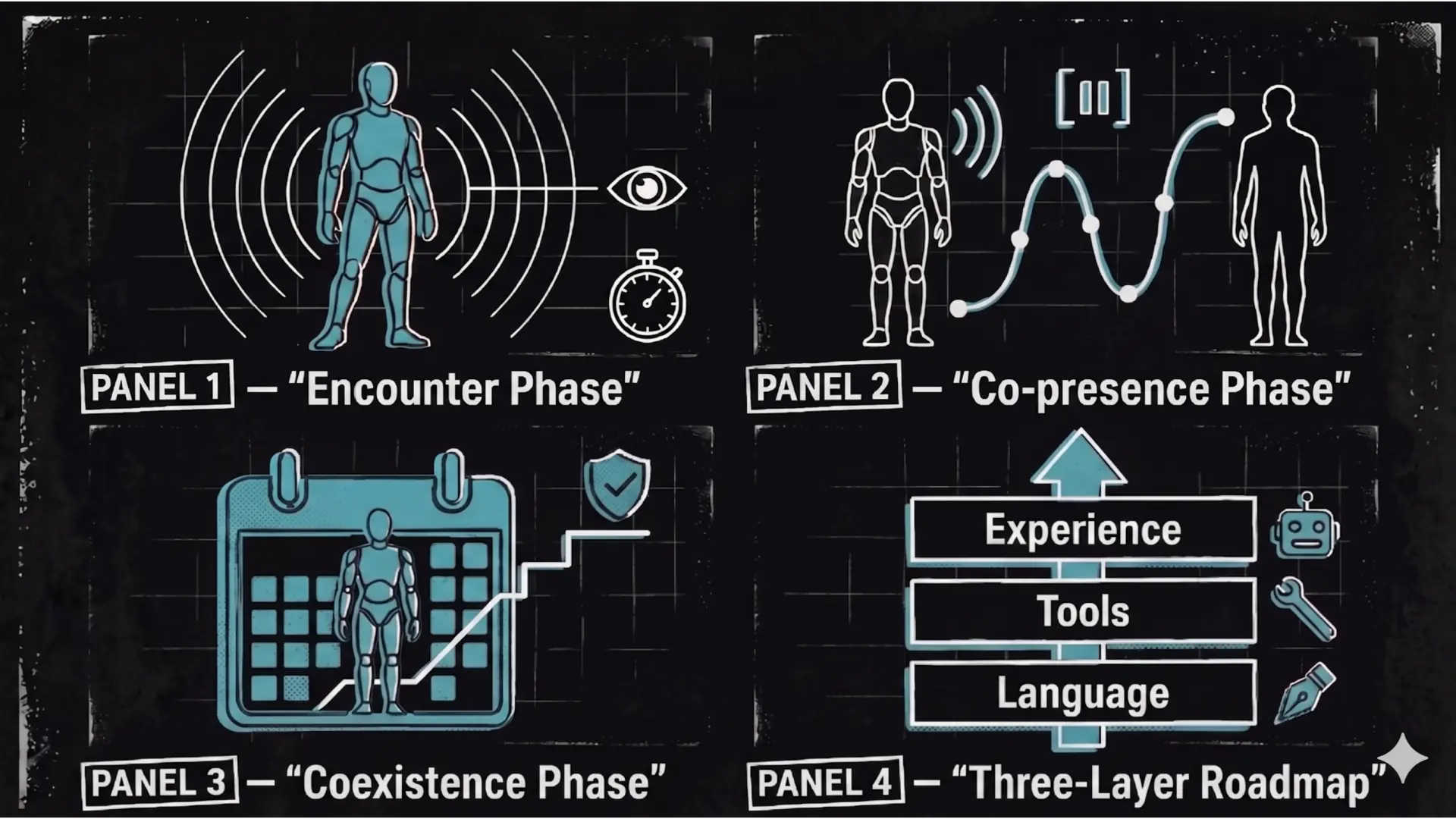
Who is responsible for the side that makes that evaluation come out positive? Engineers handle "it moves." Industrial designers handle "it looks like this." But the quality of the motion, the standing posture, the timing between actions, the screens, the sounds, the lights, the handover flow, what happens when something fails — the entire surface area of how humans and robots exist in the same room together — who designs that?
Looking at Japan's robotics industry, that person barely exists. No job postings. No defined title. The country has not yet committed to the phase of "making robots people want to use." It is still in the phase of "making robots that work."
Japan is still in the "make it move" phase
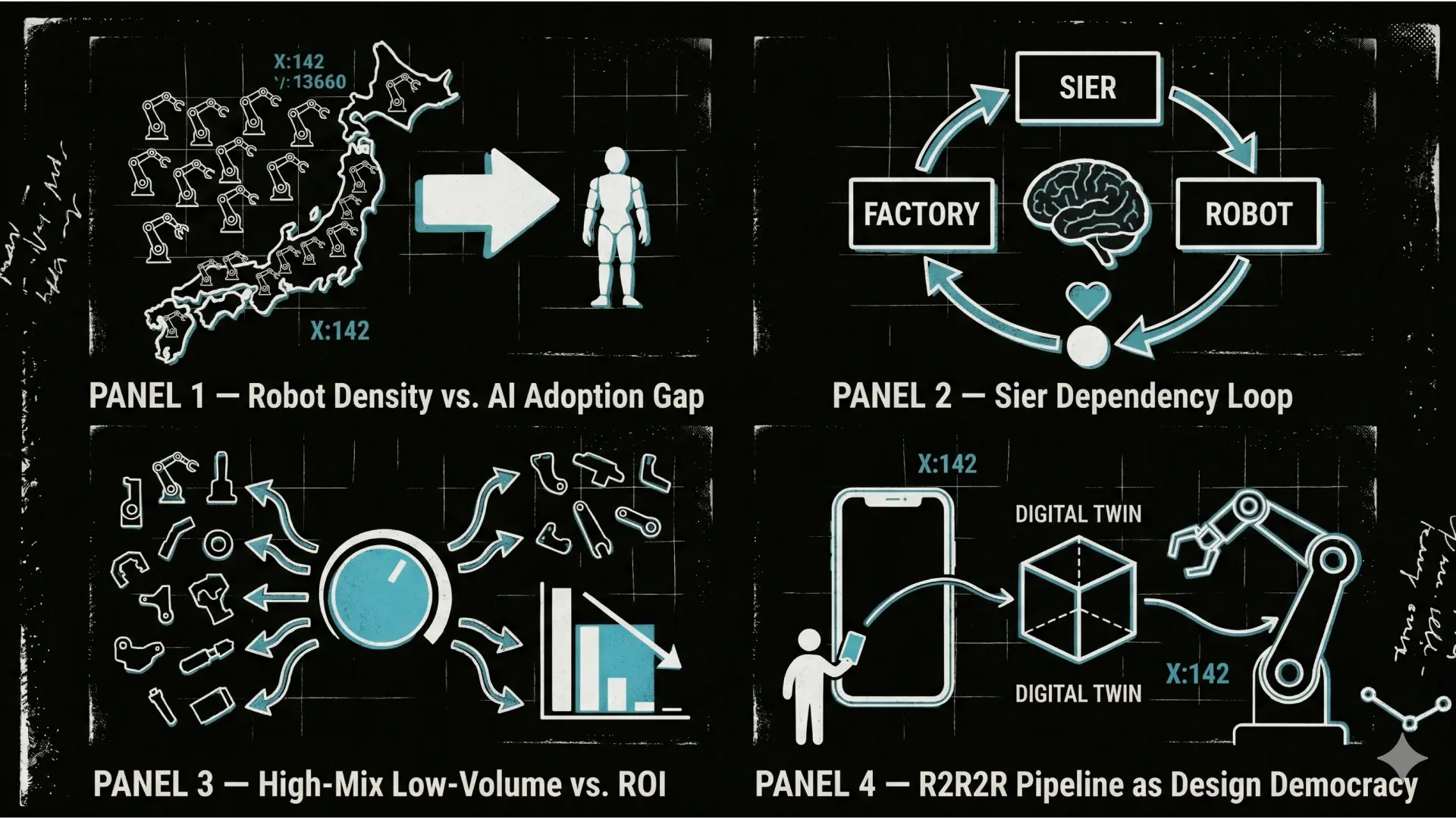
Domestic robotics startups are well into their funding rounds. Mujin, ugo, Closer Robotics, New Innovations, Akari, MOVeLOT — all of them have raised millions to tens of millions of dollars. The Japanese government has committed roughly ¥1 trillion to Physical AI over five years, with about ¥387 billion allocated in the 2026 fiscal year. SMEs can access up to ¥4.5 million per company through digital transformation and AI adoption grants.
The numbers are in place. But look at the hiring pages: robotics engineers, mechanical design, software engineers, AI engineers, manufacturing. Almost no one is recruiting designers as a standing role. Closer Robotics is listing a "Robot UI Engineer" — but that's an implementation role, not an experience design role.
Akari has over 400 employees and is moving into "Embodied AI / Physical AI." Still no designers visible. INSOL-HIGH is launching a "Physical Data Generation Center" in spring 2026, with hardware, software, and data collection teams — no UX in the org chart. The Japan Robot System Integrator Association's member companies are focused on integration and implementation. The conversation about who owns experience quality simply isn't happening.
This is the signature of absent demand. Japan's robotics industry in 2026 is mid-build, not mid-deployment. The willingness to pay for experience quality has not yet stabilized as a market.
"So there's basically no demand for robotics designers in Japan, period. At least not yet."
I accepted this as the accurate read of the moment. Then a different question surfaced.
Is this the same everywhere
If it were — if the US, Europe, and China were all stuck in the same "make it move" phase — then robotics UX would be a valid idea waiting for a market that's a decade out. But if the developed markets had already moved past this phase, then I would be looking at a phenomenon specific to Japan.
The answer is unambiguous. In the US, the profession is fully established.
Toyota Research Institute runs a formal organization called "Robotics User Experience and Interaction Design (RUX-ID) team," spanning offices in Los Altos and Cambridge. Senior UX Designer salary: $149,040 to $214,245 per year.
Johnson & Johnson is hiring Principal UX Designers for their OTTAVA and MONARCH surgical robotics systems at $157,000 to $271,400. The job description spells it out: "providing the GUI, light and sound of the systems."
Boston Dynamics has an HRI (Human-Robot Interaction) team where UX designers, 3D animators, and HRI researchers work together as a single multidisciplinary unit. General Motors goes a layer up: they're hiring a "Robotics UX Manager" — a strategic leadership role that runs UX across the entire robotics portfolio. Amazon's Industrial Robotics division is recruiting a Senior UX Designer to design interfaces for the robots running across hundreds of facilities worldwide.
These are not one-off listings. "Robotics UX Designer," "Robotics UX Manager," and "HRI Designer" function as named hiring categories.
"Is it actually different overseas?"
Completely different. The Japanese reading of the situation, applied to the US, is about three laps behind reality.
The agency model is also working
Internal hiring isn't the whole market. Design agencies are operating as external partners to robotics companies, and the model produces award-winning work.
The most visible case is argodesign, based in Austin, partnering with Apptronik on the Apollo humanoid. Apollo started as a collaboration with NASA and is now moving into mass production with Jabil. argodesign designed Apollo's overall appearance, face display, chest display, posture, and approach behaviors — the entire layer of how Apollo presents itself to a human coworker.
argodesign's website hosts a case study titled "Apollo's Odyssey: How we injected humanity into a humanoid robot." Apollo went on to win the Fast Company 2025 Innovation by Design Award. So the cycle is already running: an agency takes on humanoid experience design as a project, the work gets recognized in major design industry awards, and that recognition feeds the next contract.
frog occupies similar territory. frog's Nome project frames home robotics through a three-layer HRI / RxD / RRI model, designed by frog's teams across New York, Seattle, and Boston. Inna Lobel, Katie Lim, and others from frog's Motion UX practice are now publishing the early vocabulary of the Physical AI space.
Looking at this from Japan, you can see a complete demand chain: robotics buyer → design agency → senior individual designer. In the US, every link is already in place. In Japan, the chain has no first link. The buyer-side demand doesn't yet exist.
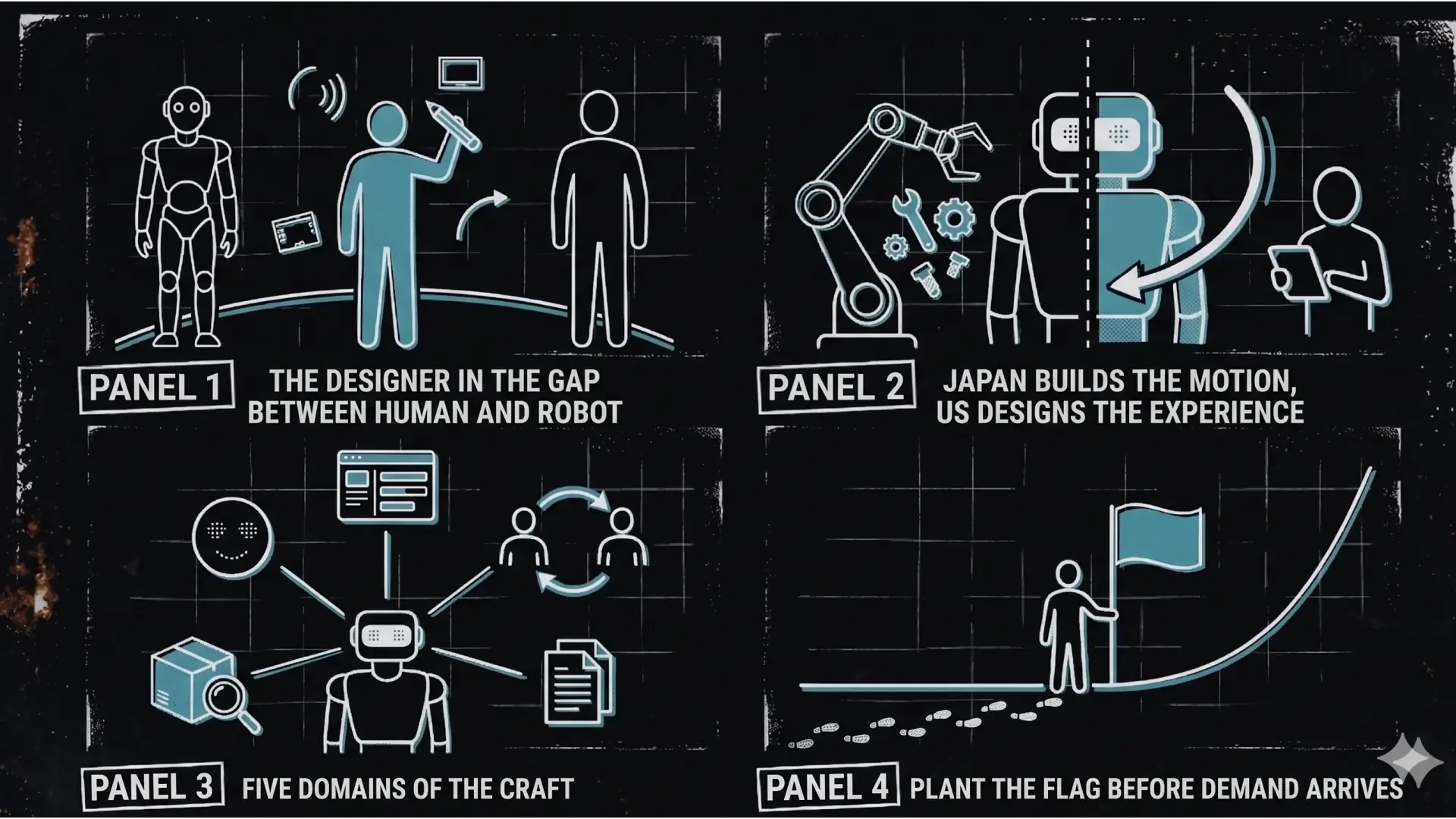
Breaking the work into five areas
This is the core of what I wanted to figure out. Pulling from real job descriptions and team structures at existing companies, I broke down what a Robotics UX Designer actually makes, day to day. These five areas form a map: when the demand eventually lands in Japan, which slot do I want to be the recognized expert in?
A. Designing how the robot behaves
The work of building the robot's "presence" — how a mechanical assembly comes across from the perspective of the person standing next to it.
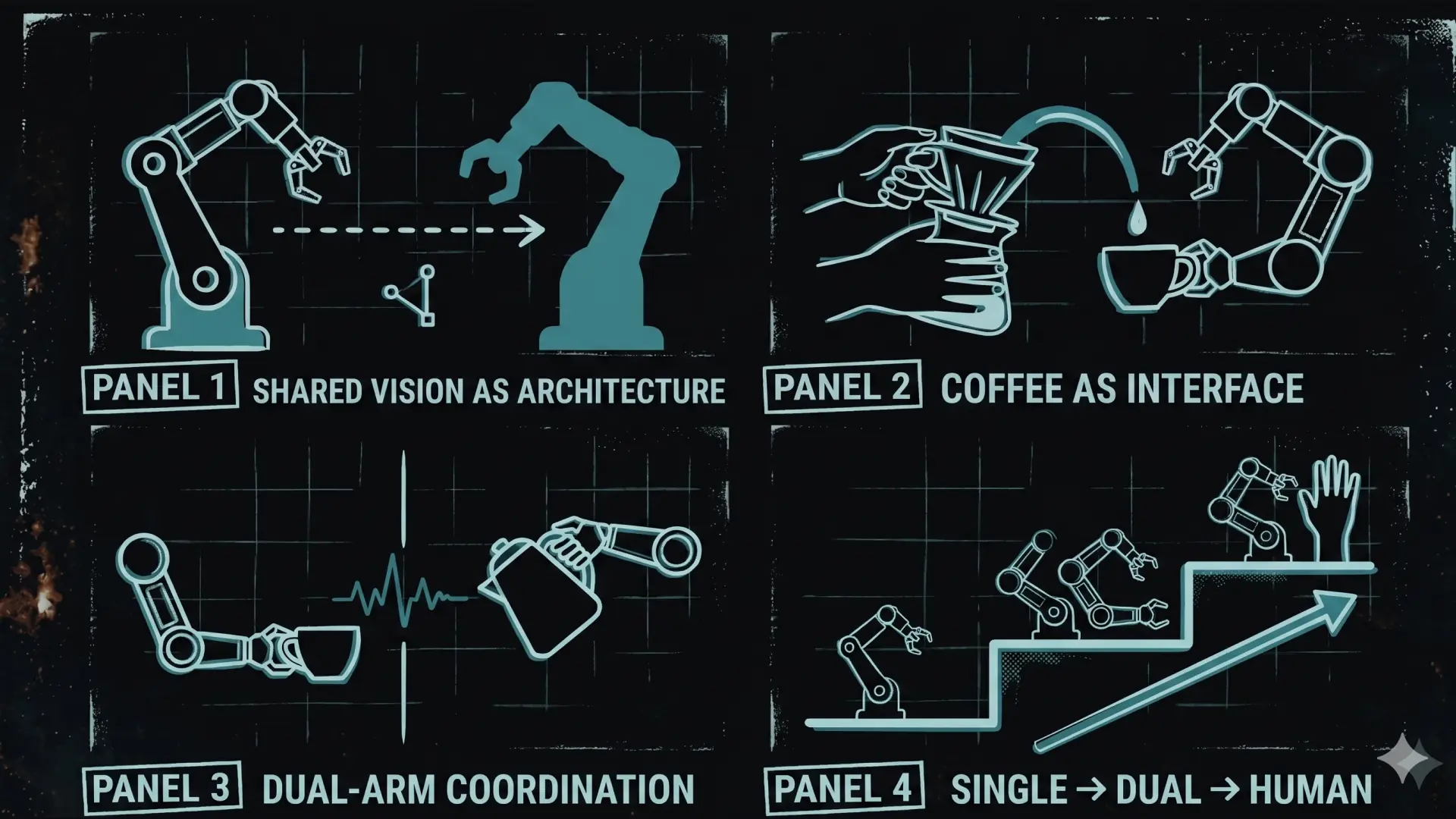
The deliverables include LED patterns, sound design (beeps, voice, ambient sounds tied to motion), what to display on the face and chest screens, idle posture, the pre-motion gesture that announces what's about to happen, stopping behavior, deceleration profile when approaching a person, overall form factor and its friendliness, and how to avoid the uncanny valley.
The Apollo case gives a concrete picture. argodesign designed the chest display to communicate battery remaining, current task, and next planned action. The face LED displays words and ellipsis symbols. The robot smiles briefly when a person comes near. Before it moves, it turns its head to indicate where it's going. When CNN and Fast Company covered Apollo, almost every article spent paragraphs on this level of detail in the behavioral choices.
What's being designed here isn't decoration. It's the information layer that lets a human read, in a fraction of a second, what the robot is thinking and what it's about to do.
B. Designing the screens for the operators
The interfaces touched by the people who run the robot, monitor it, and maintain it. This area maps directly onto UI design experience — job listings explicitly require fluency in Figma, ability to ship polished UI, and experience designing for real-time data streams.
GM's Robotics UX Manager job description enumerates the screens in scope: desktop control panels, tablet operation panels, physical buttons and indicators on the robot itself, configuration tools, operational monitoring dashboards, diagnostic tools, teleoperation camera views and control interfaces.
J&J Intuitive Surgical's Principal UX Designer listing reads: "workflows, pixel-perfect screens, and robust documentation, all tying back to applicable user requirements." The expectation is someone who can hold the entire service flow in their head while also crafting pixel-level individual screens and translating both into specifications. At the senior level, the same person is expected to extend the work across multiple product lines.
This is the same shape of work I've done for 29 years as a UI/UX designer. The only difference is the target: not an app, but a physically moving machine.
C. Designing how humans and robots act around each other (HRI)
This is the territory I've been calling Motion UX. In the US, it's called HRI (Human-Robot Interaction) and it has its own research literature, its own conferences, and its own design vocabulary.
The design surface includes every interaction that happens when a robot and a human share a space. Proxemics, the physical sense of distance and personal space. Gaze direction. How to approach and how to back away. The handover motion when passing an object. How to stop when someone walks in front of you. Acceleration and deceleration profiles that stay inside the human's predictive envelope. How to recognize gestures and how to respond to them.
Boston Dynamics' HRI team includes UX designers working alongside 3D animators with game and simulation development backgrounds. That is not a coincidence. Robot motion is designed using the same instincts as game character animation. Timing, beat, easing, anticipation, feedback — the grammar of motion that games have refined over thirty years, translated onto a physical machine.
Humans don't judge machines on function. They judge them on the accumulated quality of motion and relationship. The job is to make that judgment go well, by putting it into language, baking it into a design system, and partnering with engineers to get it implemented.
D. Validating in the field and improving after deployment
A large portion of the work is not done at a desk. The Robotics UX Designer is on site.
Amazon Industrial Robotics' Senior UX Designer listing states explicitly: "Lead user research initiatives with operators and field personnel." Fox Robotics' Product Designer description includes "Responsible for travelling to customer warehouses as needed to understand how the products are used." Travel is assumed.
What you learn in real environments is something you literally cannot extract from a lab. Does the motion feel natural or creepy? Where do operators stumble? Can the display still be read under warehouse lighting? Is the robot's speed right against the actual pace of work, or too slow?
There's a second layer to this category: the work that happens after the system ships. Tools for Humanity's UX Design Lead listing puts it precisely: "Monitor the performance of the end-to-end experience in real-world deployments. Drive iterative improvements to flows, instructions, cues, and physical artifacts based on data and field feedback." Watch the post-deployment metrics. Improve the flows, the instructions, the cues, and the physical artifacts. Keep going.
The KPIs are well defined. GM's Manager listing names them directly: usability, performance, adoption rates, satisfaction scores, safety outcomes, intervention frequency. "It moves" is no longer the bar. "It keeps getting used" is the bar.
E. Setting the standards the organization runs on (Manager role)
At the senior-to-manager transition, the work shifts from making individual screens toward making the standards that the whole organization will run on.
GM's Robotics UX Manager owns this directly: "Establish and socialize design standards, patterns, and guidelines for robotic UX and HRI, and drive their adoption across programs and partner organizations." The work is to embed HRI guidelines across internal and external programs, and make them stick.
J&J Intuitive Surgical's Principal UX Designer carries the same kind of responsibility: "Build out and ensure adherence to an evolving design system that meets the needs of multiple user interactions." Build a design system that scales across multiple robotic product lines (OTTAVA, MONARCH, future generations) and own its enforcement.
At this layer, the UX person stops being a maker and becomes a strategist. They hold the UX strategy with the executive team, hold the KPIs, lead a multidisciplinary team that includes human factors specialists and researchers. That's why the comp bands climb where they climb.
Choosing "future positioning" over "current revenue"
Laying out the five areas, what becomes visible is that the 180-plus days of Pixels to Motors have already put work into every single one of them.
Area A — robot behavior — corresponds to the design of mechArm's grasping motion, the gripper-tip sticker layout used to communicate state, the facial expression design done in the Hakobu-kun work. Area B — operator screens — is exactly the 29 years of design experience plus the Unity screens of R2R2R, ready to go as portfolio material. Area C — HRI — I've already begun the work of staking out the category vocabulary through the Motion UX / Robotics UX articles. Area D — field validation — is precisely what the dynamic visual servo work has been: physical-rig measurements like the 0.08mm stdev figure, daily logs from the actual machine instead of from a simulation. Area E — standardization — is what principles.md (P001 through P008+) is becoming, as the R2R2R methodology gets formalized.
The typical requirements in US listings read: "7+ years of UX, service design, or multi-modal experience design, ideally with hardware + software products. A strong portfolio demonstrating end-to-end systems thinking and multi-touchpoint experience design. Expertise in designing experiences that blend physical, digital, and sensory inputs. Hands-on prototyping skills in Figma, motion, audio, physical mockups." 29 years of design experience, a real robot, Unity, and a portfolio that's been public daily — there is no obvious dimension on which this falls short.
The only real obstacle is "I live in Japan, and Japan does not yet have the demand."
That single sentence reshapes the strategy. If I were optimizing for current revenue, I would route my time toward markets that do have demand — game-industry Unity work, generic UI/UX, web content — and the answer would look standard. But that path is unlikely to ever lead to Motion UX, even after a decade.
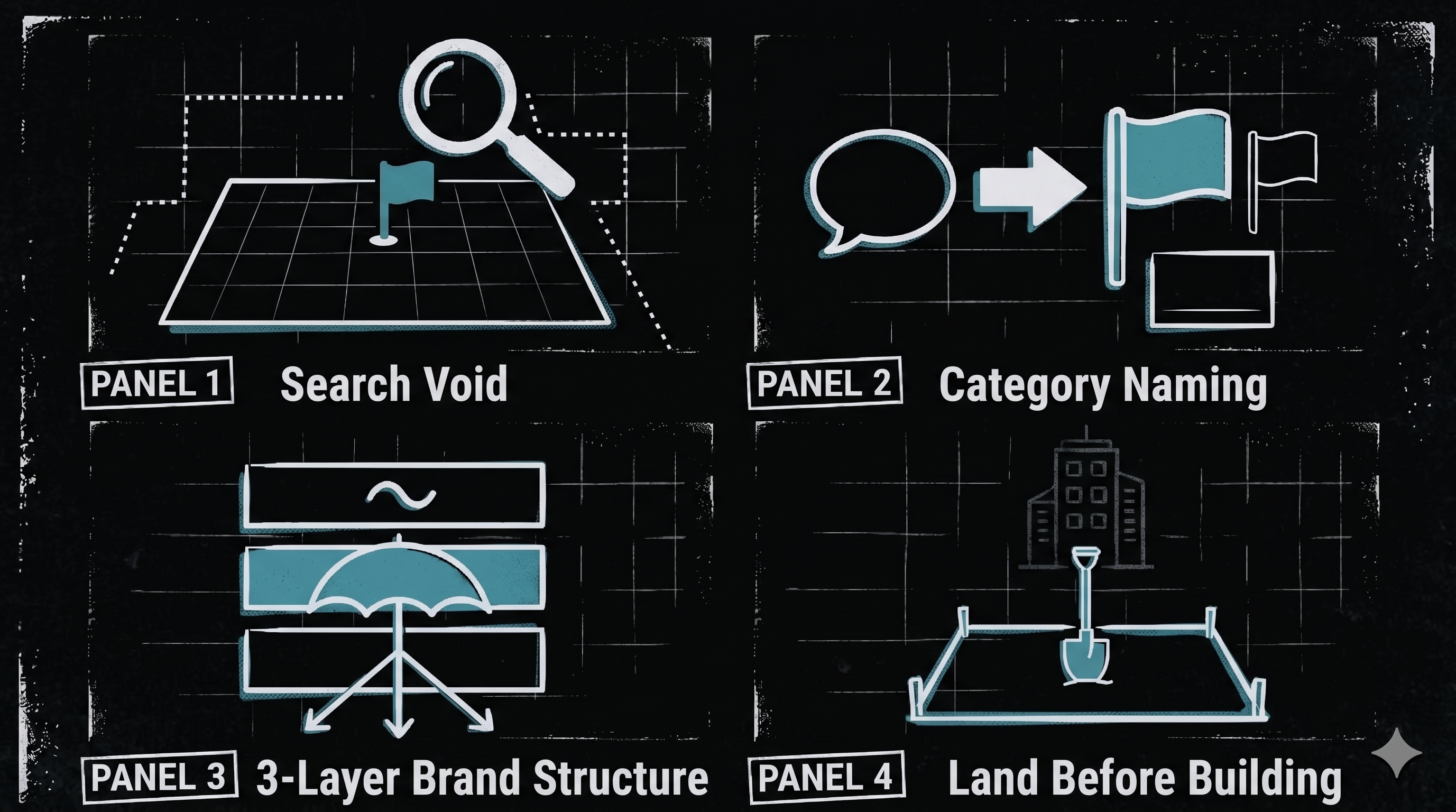
If I instead start from the future position and work backwards, the answer becomes much simpler. When robotics UX demand lands in Japan — most likely somewhere between 2027 and 2030, when humanoids start moving into homes and offices — whoever has been standing there earliest takes the category-definer slot. The same move Drift made with Conversational Marketing, Gong made with Revenue Intelligence, HubSpot made with Inbound Marketing.
Plant the flag before demand arrives. The portfolio that lets me plant it is already underway across all five areas of work that the US market is paying for. The remaining variable is whether I keep going.
The person who was already standing there
The biggest discovery in this research was that the road I was already walking on already had a name. Nobody is using the name in Japan, but in the US it's Robotics UX Designer, Robotics UX Manager, HRI Designer, and the positions exist at compensation levels in the multi-hundred-thousand-dollar range.
That changes what Pixels to Motors is. It stops being "a personal portfolio for a profession that doesn't exist in Japan" and becomes "a forward-deployed implementation log for a profession that already exists overseas." The same daily activity, two different meanings depending on the frame.
Going after a future position is what this looks like in practice. Not maximizing this quarter's revenue, but ensuring that when the demand stabilizes, the most prepared person in the country is already in the room. Direct contact with US HRI teams, joining a design agency, becoming the first Motion UX specialist on the Japanese side — all of these become available, but only if the foundation is already in place when the moment arrives.
Whether a robot feels good to work with, or strange to share a room with — that boundary is being drawn by somebody. The drawing just hasn't reached Japan yet. When it does, the person who was already standing there will be the one drawing it.