Beyond Dynamic Tracking | Dual-Arm Collaboration and the Coffee Demo
While debugging the dynamic-tracking series for mechArm 270 Pi, the conversation with Claude stopped being about implementation and started being about architecture. This is the record of what came up.
💡 Key Takeaway
After the single-arm grasping pipeline is in place, the next phase for Pixels to Motors comes into focus: dual-arm collaboration. Not one premium cobot, but two affordable arms working in coordination. The new design layer to claim is Motion UX — the relationship between motions. This is exactly where the project's position lands.
The question | The decision | Outcome |
|---|---|---|
Does the coffee demo drift from the project's direction? | Coffee was the goal from day one; switching to blocks was a hardware workaround, not a pivot | Coffee direction preserved. Only the order was swapped |
Solve it with a premium cobot (ABB CRB15000, ~$42K)? | Don't compete on hardware spec against the majors. Compete on design | Drop the single-premium-arm path |
Single-arm completion or multi-arm collaboration? | Multi-arm matches the position more tightly, and the cost stays in reach | Locked in — dual-arm collaboration is next |
Sharing the Destination
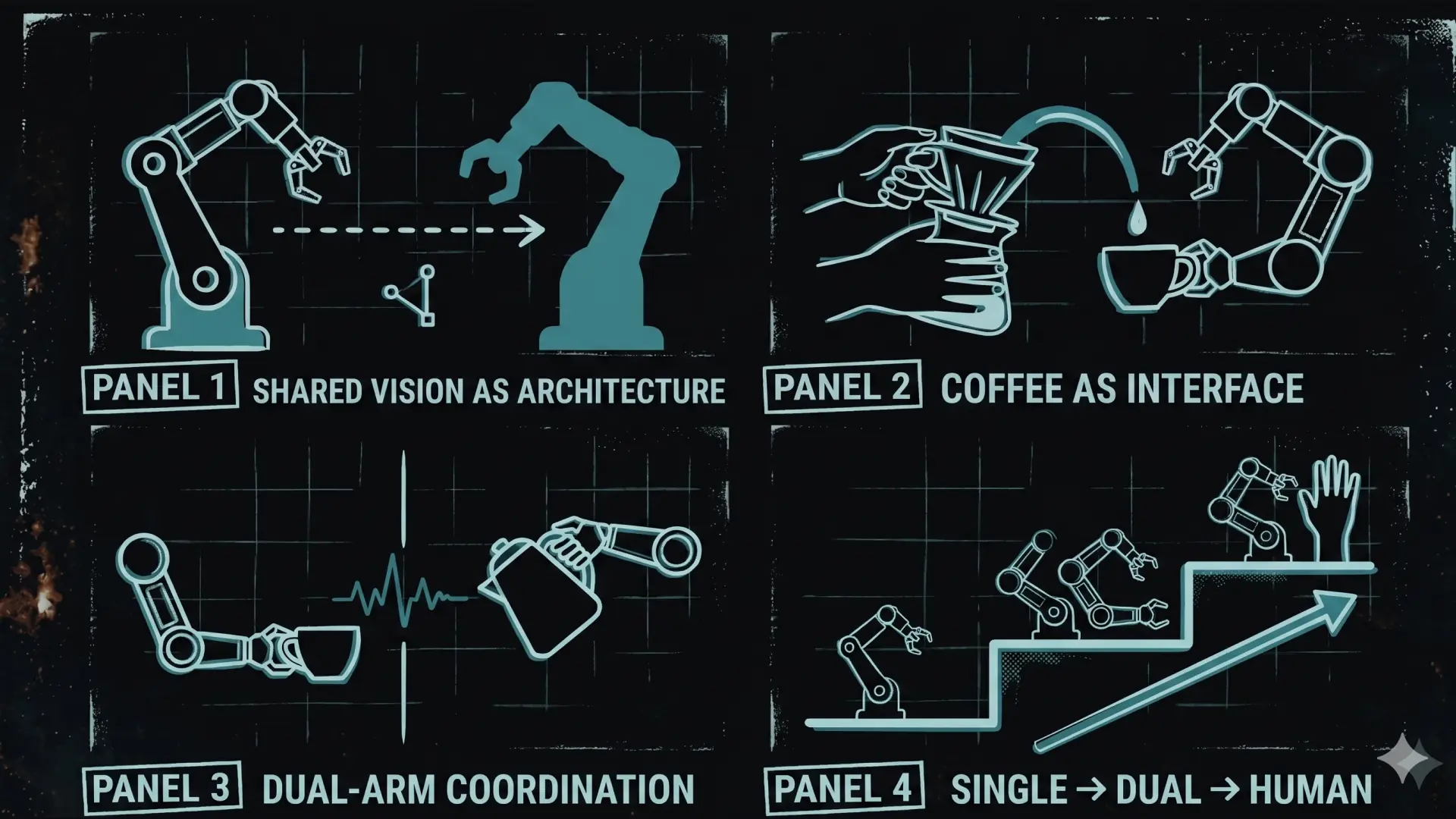
Single-arm visual servoing and grasping have to land first. That's obvious. But always keeping the destination visible — and sharing that view with the AI — matters too. Showing where the current work is heading helps with planning, with figuring out what's needed, with everything.
— When the destination is shared, the AI's judgment changes. When only the task is, it doesn't.
Take the visual-servoing code. A Claude that only knows "we need single-arm grasping to work" writes code optimized for mechArm specifically. A Claude that knows "we're heading toward dual-arm collaboration" splits functions by "the responsibility of one arm" and takes the arm instance as an argument. The second version requires far less rewriting when the second arm shows up.
The fact of seeing ahead changes the design of what's in front of you right now. This rarely comes up in Build in Public conversations, but in working with AI on long-running projects, shared sight is what determines the lifespan of the code. Without it, every interaction produces locally optimal code, and the design debt compounds invisibly.
Once the destination is on the table, every downstream decision — hardware purchases, Unity scene setup, FK scan structure, article callbacks, how to read failures — gets evaluated against "the next phase." Sharing the destination isn't an efficiency question anymore. It's an architectural one.
The Pull of a Coffee Robot
Setting aside the actual work content — as a demo for general audiences or industry people, a robot arm brewing coffee or a one-day pop-up café has serious pull.
— Holding onto content with strong pull is strategically necessary to reach the inner circle of contacts.
There's a channel called Loupe that posted a video titled "The Coffee-Bot." It's a beautiful demo of ABB's CRB15000 — a premium collaborative robot — brewing coffee.
The CRB15000 lists at around $42,188 (roughly 6–7 million yen). Actually running it requires peripherals and integration, and the total often pushes past 10 million yen. "A robot that brews coffee" is, in the industry's current understanding, an experience that requires this scale of investment.
"A robot brewing coffee" needs zero explanation. On social media, in articles, at exhibitions — it lands on people who aren't in the field, with content that has a long reach. Running it as a pop-up café puts the experience into people's actual memory and produces word of mouth. The core contact list isn't reached directly, but if the recognition lands as "that person doing coffee with the cheap hardware" — through the timelines those contacts already scan, through acquaintances outside the industry — then a path opens toward R&D conversations and citations of the work.
Treating primary metrics (citations of the language, engagement from the core list) and secondary metrics (followers, page views) as opposed was a sloppy framing. Wide reach and deep reach aren't either/or. Close the wide tap and the deep one dries up too. The coffee demo is the strongest interface for landing Physical AI in a general context.
Single-Arm Completion vs. Multi-Arm Collaboration
How robot work gets organized splits, broadly, into two directions.
Solving it with a premium cobot crossed my mind. But if that's the move, it doesn't really need to be me doing it. Trading punches with the majors on hardware spec doesn't win, and even if it did, that wouldn't be the Pixels to Motors story.
Direction | Design philosophy | Cost structure | Strength | Weakness |
|---|---|---|---|---|
A: Single-arm completion | Make the task work through hardware spec | Hardware unit cost scales linearly | Simple. Established methodology | Hard for an individual to produce novelty |
B: Multi-arm collaboration | Suppress hardware spec; solve through count and coordination | More units, but the total can stay low | Large design margin, new territory | Synchronization and collision avoidance become harder |
The majors already own that game. Payload, precision, reach — they've spent decades optimizing it. The CRB15000 sits on that line.
Direction B, by contrast, hasn't been systematized by anyone. GEN-1 from Generalist, Toyota Research Institute's LBM 1.0, Real2Render2Real — the frontier of Physical AI is already moving toward dual- and multi-arm configurations. But these are research organizations working with expensive hardware. There is no canonical, individual, low-cost implementation example.
That's the gap where Pixels to Motors fits.
Why Multi-Arm Fits the Position
Reading the project's three brand pillars through a dual-arm lens:
Pillar | Single-arm context | Dual-arm context |
|---|---|---|
Intersection of UX × AI × Robotics | Easy to ride existing discussions | Stand where no one else is standing |
Low cost with iPhone as the entry point | Proven with mechArm alone | Two arms still under 150,000 yen combined |
Design from experience backward | Talk about motion quality | Talk about motion relationships |
Dual-arm collaboration sharpens the project's position — more than the single-arm configuration ever could.
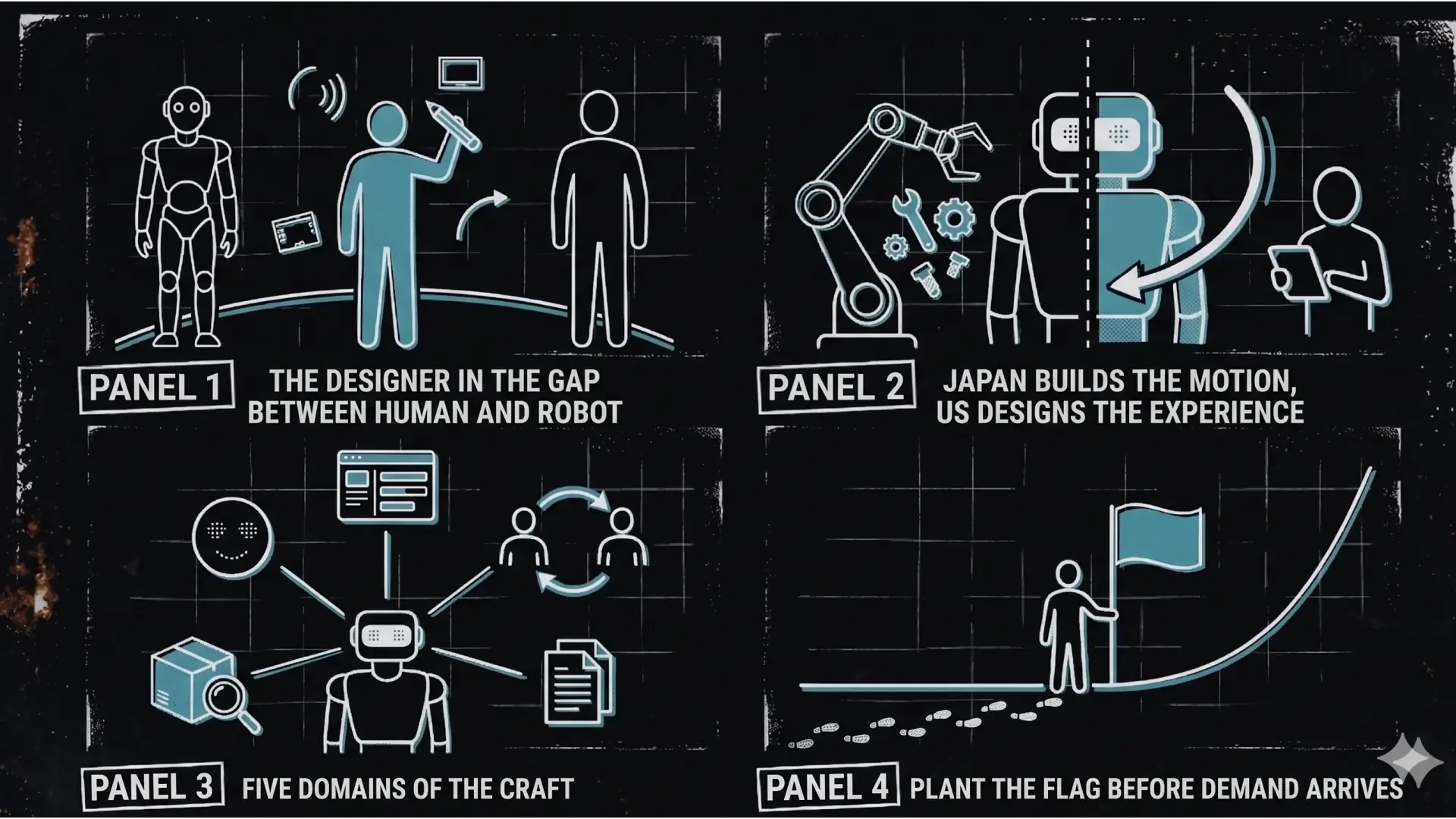
A single robot's motion ends at the question of "motion." When there are multiple, a new design layer appears: the relationships between motions. Who moves first. Who waits. The timing of moving the instant the other one pulls its hand back. The quality of stopping right before a collision. Who recovers when something fails. These are the same structural problems UX designers have spent decades on — designing relationships between people, between screens and people — and they're where UX experience finally has somewhere to land inside robotics.
And "robot-to-robot collaboration" is technically continuous with "human-to-robot collaboration." Synchronizing two robots is structurally the same problem as synchronizing a robot with a human: observe the partner's motion in real time, predict intent, adjust your own motion to fit. What gets solved between two mechArms transfers directly to "a robot and a person brewing coffee together." Dual-arm is the stepping stone to human collaboration.
The Coffee Demo Comes Alive in Dual-Arm Configuration
Reassembled in dual-arm form, what a person does with two hands in a café decomposes naturally into two robot arms.
One arm supports the cup / the other operates the dripper
One arm holds down the bean bag / the other pours
One arm carries a temperature sensor / the other controls the water volume
That's a design that never falls out of a single premium arm. The Coffee-Bot completes its work beautifully with one arm — but the dual-arm configuration tells a different story. The approach of decomposing a human gesture across two arms is itself what raises the Motion UX conversation.
The Order Matters
Land single-arm visual servoing and grasping first, then move to dual-arm.
This stays as a hard rule.
What doesn't work on one arm won't work on two. If a single arm can't pick up a red block, adding a second arm only makes it worse. Stacking complexity on top of a missing foundation produces unfixable bugs.
Dual-arm doesn't double single-arm's problems — it squares them. Synchronization. Collision avoidance. Coordinate-frame alignment. Each issue compounds against the others, and the existing toolchain wasn't built for two.
The Build in Public log from single-arm becomes the design foundation for dual-arm. Everything learned along the way — FK scanning, visual servoing, grasping conditions, the probe-style REFINE — holds as a premise once the second arm shows up. Finishing single-arm cleanly is actually the fastest path to dual-arm.
The moment grasping lands, the decision "two arms now" becomes possible. Until then, completing the current pipeline is the shortest route.
Hardware Options
When the dual-arm phase starts, the choice reduces to two configurations.
Symmetric: mechArm 270 Pi × 2 — same hardware, same API. Code sharing is maximized. Payload stays around 150g for both, so it's lightweight objects only.
Asymmetric: mechArm 270 Pi + myCobot Pro 630 — built around role division. The Pro 630 (2 kg payload) is the "holder," mechArm is the "operator," etc. Total cost lands around 1.2 million yen.
The asymmetric setup makes the heavy-role / light-role division natural and can handle a coffee cup. The symmetric setup is cleaner code-wise and makes a more beautiful reference implementation of dual-arm collaboration.
The decision can wait until single-arm grasping lands and the specific demo task for the next phase becomes concrete.
Sharing the Destination Is Itself the Design
This session's real outcome wasn't the technical conclusion. It was the act of sharing the project's mid-to-long-term direction with Claude itself.
Once the destination is on the table, every decision — code structure, hardware purchases, article callbacks, how failures get read — gets framed against "the next phase." Build in Public conversations rarely cover this. But with AI on long projects, shared sight is what determines the lifespan of the code.
Sharing the destination isn't an efficiency question. It's the architecture.
One arm becomes two. Two becomes coordination. Coordination becomes Motion UX.
That's where this is heading.