There's No Such Thing as a Free Lunch — On Dependency Design in the Age of AI Agents
A post went viral on X yesterday. "People who kept using Claude Code raw are winning big." 290K views. The replies kept circling around the same pattern: the more elaborate your setup, the harder you got stuck. What are we trading away for convenience? The whole thread quietly revealed something fundamental about how AI services actually work.
💡 Key Takeaway
The deeper you embed AI agents, the more violently your operational cost explodes when the provider shifts direction. "There's no such thing as a free lunch" hits hardest in the AI era. The surface cost may be zero, but you pay through process lock-in, dependency acceleration, and exit difficulty. Stop asking "is this convenient?" Start asking "how much will it cost me to recover when this breaks?" That single shift changes the resilience of everything downstream.
What we observed | The underlying structure | The healthy response |
|---|---|---|
People who used the AI tool raw outperformed people who built elaborate setups | Wrapper tools and abstraction layers are fragile against upstream changes. The vendor maintains the core; the ecosystem doesn't | Separate the layers where dependency is acceptable from the layers where it isn't |
The cost of an AI agent spec change is far higher than a regular SaaS spec change | AI is probabilistic, backward compatibility is weak, tests are hard to write, debugging is opaque — all at once | Deep integration only if you build it yourself. Avoid full dependency on external services |
Free and cheap AI services are structurally bound to raise prices | GPU inference costs, investor recovery cycles, lock-in strength, and quality-based competition all compound | Treat future price hikes as already baked in. Always keep an exit option ready |
The Pattern: Raw Users Won
The post on X was simple: "People who kept using Claude Code raw are winning big." It pulled 290K views, and the replies told the rest of the story.
The pattern was clear. People who built elaborate abstraction layers — Skills Managers, SDK integrations, wrapper ecosystems — got stuck the moment the underlying service shifted its specs or pricing. People who used the tool plainly, as it was, didn't break. One reply nailed it: "Sinking people deep into the swamp and then saying 'from here on it's paid' — that's brutal."
I've been using it raw the whole time, so I'm fine.
— Not stacking the surrounding ecosystem turned out to be a form of risk hedging.
This pattern repeats. New frameworks, trendy wrappers, convenient management tools — the people who ride them get stranded when the provider changes course. The core provider maintains the core. The ecosystem around it doesn't get the same treatment.
This isn't new. Look at web development history. Sites that depended heavily on jQuery plugins fell into maintenance hell. Business systems built on Flash died the moment browsers dropped support. "Flashy convenience versus plain fundamentals" — that tension has played out over and over, in different costumes.
Now the same play is running in the AI world. The difference is the speed and the depth. When an AI provider changes direction, there's no grace period. And AI agents embed themselves deeper into business workflows than any previous tool category, which means the lock-in is in a different league.
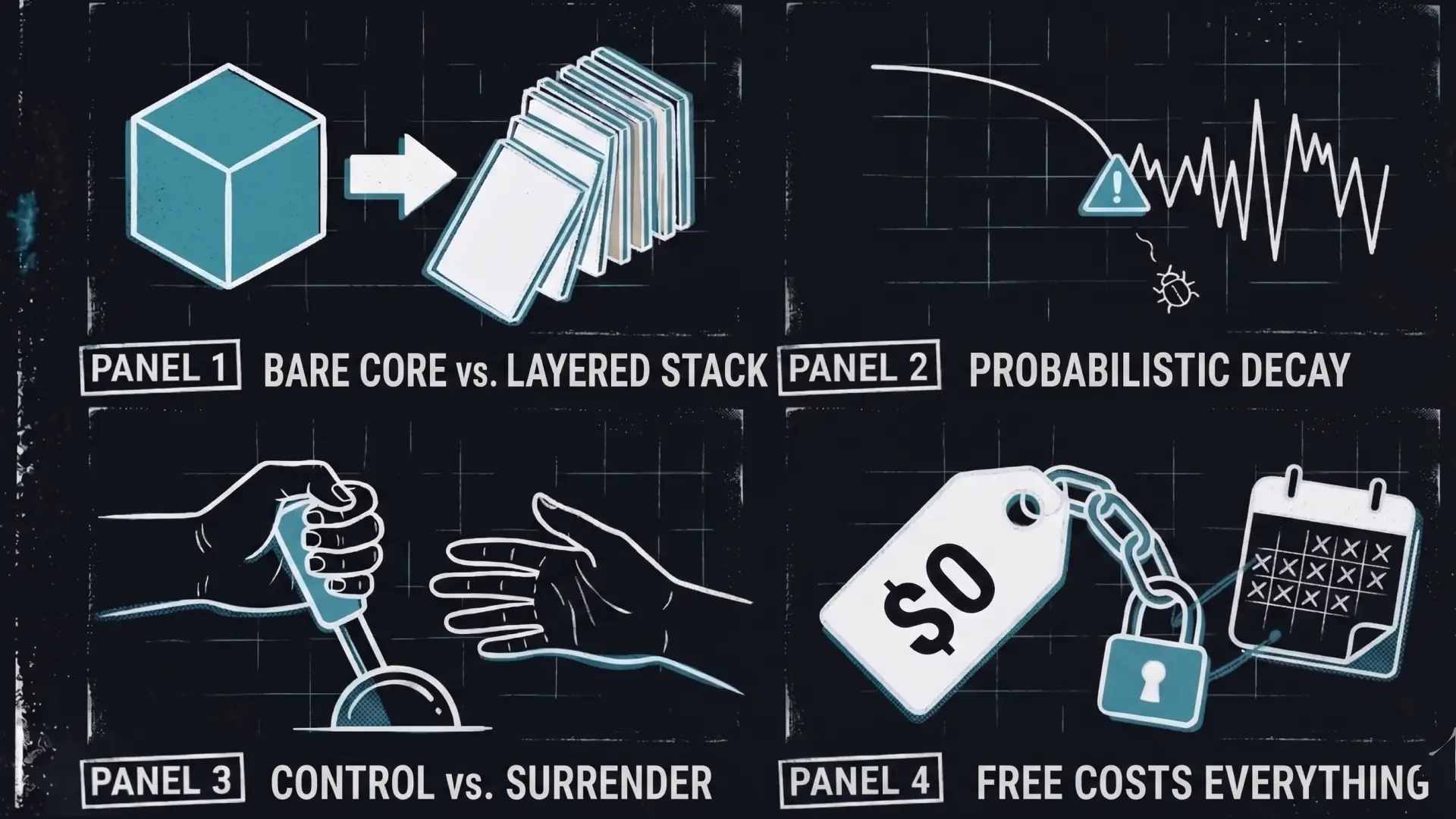
The more convenient the surrounding tools, the more fragile they are against changes upstream. People who used only the core paid a small adapter-layer cost. People who stacked wrappers paid at every layer. Simplicity, in exchange for inconvenience, buys you resistance to change.
The Fear of Turning AI Agents into Systems
Once you build an AI agent into a system, the operational cost of every upgrade or policy shift is catastrophic.
— The blast radius of any change is bigger than ordinary software.
In a normal system, an API spec change can be absorbed by the interface layer. The adapter pattern handles it. AI agents don't work that way. When something changes, the impact ripples through the entire system.
These changes happen routinely:
Model version bump → subtle behavioral shifts → prompt re-tuning required
Output format change → rewrite the parsing logic
Context window or pricing change → reconsider the whole architecture
Tool-calling spec change → workflow-wide propagation
Safety policy update → tasks that used to work now get rejected
And these changes often arrive with little or no advance notice. AI development competes on speed, so backward compatibility guarantees are weaker than what traditional cloud services offer. AWS and GCP typically give years of grace before deprecating APIs. AI providers ship new model generations on a six-month cycle and simply can't afford that kind of runway.
In other words, backward compatibility is an aspirational goal, not a contract.
What makes it worse: agents behave probabilistically. When something goes wrong, it's hard to tell whether the system "broke" or just "failed this time." Regression tests are painful to write. Performance can rot quietly in production. By the time someone notices, weeks or months of business data have already been touched by the degradation.
Type of change | Regular SaaS | AI agent |
|---|---|---|
API spec change | Patch the interface layer | Rewrite prompts wholesale |
Price increase | Adjust the budget | Reconsider the architecture |
Behavioral drift | Surfaces as a bug | Rots quietly in the background |
Backward compatibility | Usually guaranteed | An aspirational goal at best |
Testability | Deterministic given input | Probabilistic, hard to reproduce |
Debugging is the other half of the problem. With traditional systems, you trace the logs and find the cause. With AI agents, you have to figure out whether the issue lives in the prompt, the model update, the context construction, or the tool-calling layer. The investigation cost scales with how deeply you embedded the agent.
From an organizational angle, this is a structural maintenance problem. Two or three engineers can keep a traditional system running. Once an AI agent is wired into business workflows, you need ongoing prompt engineering expertise, awareness of model-specific quirks, and constant tracking of provider update notes across multiple vendors. That's a different skill set, and the headcount cost moves with it.
The Decisive Gap: Builder Side vs. User Side
If you're building the AI or the system yourself, fine. But pushing every business process onto an AI agent is the worst possible choice.
— Whether or not you hold the dependency structure.
If you're on the builder side, you can swap models, rewrite prompts, or in the worst case, replace the AI with your own logic. When specs change, you can locate the change and respond. That gives you the right to embed deeply. If you design with an abstraction layer over multiple LLM providers from day one, you keep the option to switch when one vendor raises prices or shifts direction.
The user side doesn't have that option. The dependency structure isn't yours. When the provider changes course, you either follow or quit. Structurally, this is the same as outsourcing your entire business process — all the leverage sits on the other side. If the vendor says "next month, prices triple," you pay.
In other words, the question is whether you still hold the steering wheel of your own operation.
The industry hasn't standardized yet. Cloud services have migration tools and well-worn playbooks for moving from AWS to GCP. AI agents don't. Every provider has its own philosophy, its own API, its own conventions for prompts, tool calls, and output structure. Migration costs are high, and that height is exactly the provider's business moat.
Here's the line between healthy and dangerous use:
AI as a productivity multiplier → healthy. Humans can keep working if AI disappears
AI as advisory input on decisions → healthy. Final judgment stays with humans
Delegating both judgment and execution to AI agents → only acceptable if you built it yourself. Full reliance on external services is risky
Anchoring entire business processes on AI agents → risky even if you built it. Worst case if you rely on external services
The desire to "automate everything with AI" makes sense as an aspiration. But three preconditions have to hold first: in-house build capability, change-tracking capability, and a viable fallback. Without those three, full automation just becomes a slow rope around your own neck. The agent runs beautifully — until it doesn't, and at that point, nothing remains inside the organization.
And there's a deeper risk that gets overlooked: judgment externalization. Every time judgment gets delegated to an AI agent, the human side quietly loses the ability to make that judgment alone. When the AI becomes unavailable, the organization no longer knows how to run that work. This is worse than technical dependency. Recovery requires retraining people, and that takes years. Short-term efficiency, paid for with long-term independence.
Price Hikes Were Baked In From Day One
Free stuff is the scariest. The dependency risk is huge. And AI is genuinely useful, with an absurd number of users. Price hikes were inevitable.
— "Raise prices later" was always part of the structure.
AI service pricing is structurally bound to climb. Anyone watching the market could see this coming. Here's why:
1. The cost structure of inference Traditional SaaS is a marginal-cost-near-zero business. One server can handle ten thousand users. AI inference consumes GPU compute per request. As users grow, costs grow linearly — sometimes worse. The more users you carry on a free or cheap plan, the more the provider bleeds. With the global GPU shortage still ongoing, near-term cost improvements aren't really on the table.
2. The investor recovery cycle Today's AI industry runs on enormous VC capital aimed at the "user acquisition phase." But investors eventually want their money back. Once share is locked in, prices become the recovery mechanism. Uber, Netflix, SaaS — same pattern. Start cheap, capture share, complete the lock-in, then raise prices.
3. The strength of the lock-in The deeper you use an AI service, the more your custom workflows, prompts, and embedded processes pile up. The lock-in is stronger than typical SaaS. Vendors calculate that customer tolerance for price hikes is correspondingly higher. The higher the probability that customers will "pay rather than migrate," the more aggressively a vendor can raise prices.
4. Competition runs on quality, not price Model performance drives purchasing decisions. Price wars don't take hold. "I'll switch because it's cheaper" loses to "I'll pay because the performance is better." That dynamic, too, makes price hikes easy to defend.
In other words, "it's free, so it's safe" doesn't hold.
The real danger of free services isn't just "get them hooked, then charge." It's the possibility that the operation itself doesn't survive. Vendors that can't carry the deficit eventually shut down or impose sudden feature restrictions, and users pay the price. Free users sit at the bottom of the priority list — they get cut first.
We've seen this before. Google Reader, Google+, Picasa, countless free API services. "Convenient, so I keep using it" ends in sudden shutdowns and frantic searches for alternatives. The same future is waiting in the AI space. Given the high infrastructure cost of AI, the risk of shutdown or major feature restrictions is arguably higher than what traditional SaaS exposed users to.
What "There's No Such Thing as a Free Lunch" Reveals
The old proverb hits hardest in the AI era. Maybe more than at any previous moment.
The cost of a free AI service isn't zero. It just doesn't show up on the price tag. It gets paid somewhere else.
Surface cost | What you're actually paying |
|---|---|
Free or low-cost | Lock-in of business processes |
Easy to adopt | Speed at which dependency deepens |
New features arriving constantly | Difficulty of leaving when prices rise |
Generous support | Subordination to the vendor's business agenda |
Automatic data sync | Your data accumulates as the vendor's analytical material |
By the time the dependency runs deep, pricing changes can't be escaped. If the service shuts down, there's no alternative. Spec changes have to be accepted. All of this is latent cost from the moment of free adoption — invisible at the time of decision, but quietly real.
Beyond operational dependency, cognitive dependency is also at stake. The more often AI agents make the calls, the more judgment capacity humans lose in that domain. When the AI becomes unavailable, the organization doesn't know how to operate. This is deeper than technical dependency, and recovery means rebuilding from human training. Short-term efficiency, paid for with long-term independence.
Stop asking "is this convenient enough to adopt?" Start asking "when this breaks from external causes, how much work — how many hours, how many dollars — will it cost me to recover?" That single shift in framing changes resilience at every layer downstream. Don't chase short-term efficiency. Choose designs that don't shatter over the long term. That's the new literacy of the AI era.
And one more thing: always keep "not using it" as an active option. Refusing to embed AI agents into your business looks, at first glance, like a competitive disadvantage. But staying un-dependent is sometimes the strongest competitive position you can hold. When prices change, when specs shift, when a service shuts down, the un-dependent party watches calmly and chooses the next move. The dependent party only has one option: follow.
Convenience is a lot like a drug. Distributed free at first, devastatingly effective, impossible to put down. By the time you notice, the cost of leaving outweighs the cost of staying. The tech industry has run this pattern many times. The AI era is restaging it at the largest scale yet. A single 290K-view post on X surfaced the current form of this universal trap.
The boundary line is something we'll keep returning to.
Distinguish between layers where dependency is acceptable, and layers where it isn't. That is the most important judgment axis we have right now.